I seek to empower people by giving them something to ponder.
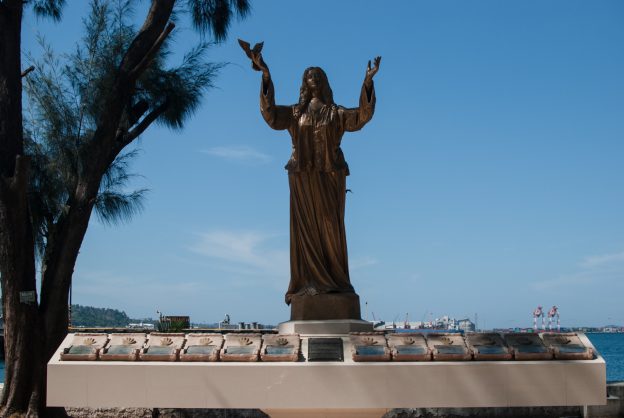
(Cover Photo: Subic Bay monument to the 12 Senators that voted for the closure of the U.S. naval base on September 16, 1991. Credit: Sebastian Strangio)
By Marcial Bonifacio
11/9/26
My friends and countrymen, the question of whether the Philippines would be better or worse today had the United States retained its naval base at Subic Bay is not merely a matter of historical curiosity. It is a question whose answer is written in occupied reefs, militarized artificial islands, and the tens of thousands of Filipino jobs that now exist where American warships once anchored. The evidence on both sides demands honest reckoning, and it begins with what happened when the United States left.
On September 16, 1991, the Philippine Senate voted 12 to 11 to reject renewal of the Military Bases Agreement, ordering the United States to vacate Naval Base Subic Bay by the end of 1992. The last American ship, the USS Belleau Wood, departed on November 24 of that year, ending a military presence that had begun when the United States acquired the Philippines from Spain under the Treaty of Paris in 1898. The prevailing fear in Washington at the time was stark: then-US Ambassador Nicholas Platt warned that foreign investment would dry up and the economy would collapse if the US bases pulled out.
That prediction proved entirely wrong. Mayor Richard J. Gordon of Olongapo City, who would become the first chairman of the Subic Bay Metropolitan Authority, transformed the former naval installation into the Philippines' first special economic and freeport zone under Republic Act 7227, the Bases Conversion and Development Act of 1992. Gordon himself stated: "Even before the departure of the US forces, I already had a vision to convert the naval base into a Freeport."
Within four years, the Subic Bay Freeport had created 200,000 jobs and generated US$2 billion in foreign investment. By December 2008, the zone employed 87,502 workers — more than three times the number employed by the US Navy at the height of its operations. By 2023, the workforce had grown to over 162,000, nearly five times what it was in 1992.
On the economic record alone, the case for the closure holds. The Freeport's success depended entirely on the transfer of 680 square kilometres of developed US military infrastructure to Philippine civilian authority, an economic foundation that could not have been created alongside a continued American military presence.
The Philippine Constitution, under Article XVIII, Section 25, requires that any foreign military presence on Philippine soil be authorized by a treaty ratified by the Senate, a provision drawn directly from the American system of government, one that Philippine lawmakers rarely acknowledge and Filipino voters almost never consider. That provision, invoked in 1991 by the twelve senators whose monument now stands at Subic Bay, was the legal basis for the closure.
The constitutional argument for sovereignty was not wrong. But sovereignty exercised in a vacuum of military capability is not sovereignty. It is an open invitation to those with both the will and the weapons to take what they want.
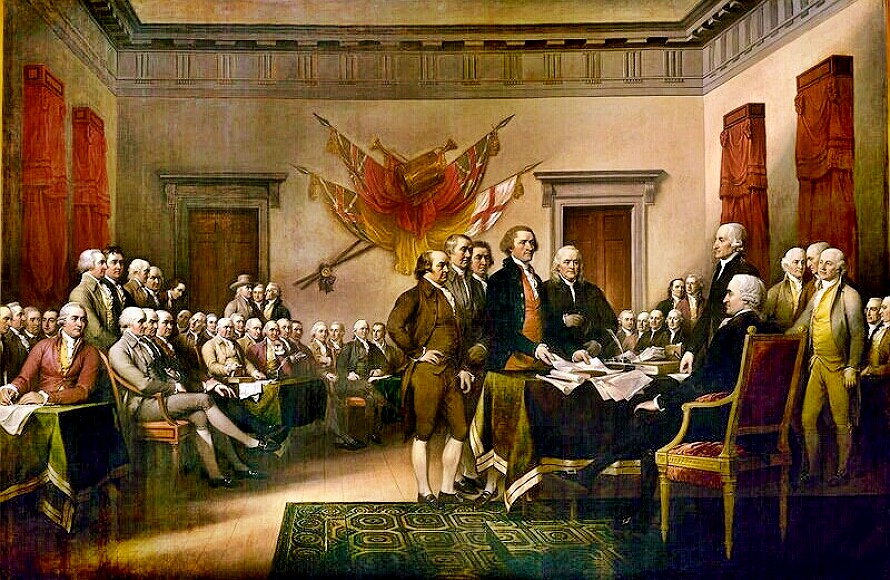
George Washington stated before Congress in January 1790: "To be prepared for war is one of the most effectual means of preserving peace." The American founders, whose constitutional architecture the Philippine Senate invoked in 1991, understood what every Philippine government since has relearned: that a nation which cannot defend its territory does not truly possess it.
China enacted its Law of Territorial Waters in 1992, codifying its expansive maritime claims into law within months of the final American departure, and then proceeded to occupy Mischief Reef, Scarborough Shoal, and a chain of artificially constructed military islands across the West Philippine Sea. That sequence of events was deliberate. As I have documented in 8 Nations, 14 Aggressions: China's 2,500-Year Invasion Record, China's pattern of calculated territorial expansion reaches back across two and a half millennia and fourteen separate aggressions against neighboring nations. The Mischief Reef occupation was not opportunism. It is the documented record of a great power exploiting a strategic vacuum, one that the Philippine Senate created by a margin of one vote.
The economic case for the closure, however, ends precisely where the case against it begins. Within three years of the last American ship leaving Subic Bay, the consequences of the resulting strategic vacuum became undeniable.
In early February 1995, Filipino Navy patrol vessels discovered eight Chinese ships and newly erected concrete structures flying a Chinese flag on Mischief Reef, a submerged reef within the Philippines' own exclusive economic zone, barely 240 kilometres off the island of Palawan. It was the first blatant violation of Philippine territorial sovereignty since the country lost its external defense deterrent in 1992.
The weakness of the Philippine armed forces, which had long depended on the American military presence as a de facto deterrent, provided China with the opportunity to extend its claims without military confrontation. As the Christian Science Monitor reported in February 1995, it was tantamount to an invasion.
Marvin Ott, Professor of National Security Policy at the National War College and former Southeast Asia chairperson at the Foreign Service Institute, has stated without equivocation: "The Chinese decision to establish a position in Mischief Reef would not have occurred if the US was still at Clark Air Base and Subic Base." A senior Philippine official who participated in the November 1996 state visit of Chinese President Jiang Zemin to Manila later recalled that Zemin conveyed the view that the moment China occupied Mischief and put up structures on the reef, the Philippines had lost it, because in international politics, occupation is identical to sovereignty.
Today, Mischief Reef is no longer a cluster of octagonal huts on stilts. It is a fully militarized Chinese outpost with a 3,000-metre airfield runway, radar systems, and warehouses that defense analysts assess to house surface-to-air missile systems, all built on land China reclaimed from what was once an open reef in Philippine waters.
Mischief Reef was not the last loss. In 2012, China seized Scarborough Shoal, located just 200 kilometres from Subic Bay, after a tense standoff with Filipino forces who could not compel Beijing to withdraw. Across the top military brass of the Philippines today, the view is uniform: China would not have taken over Mischief Reef had US forces remained in the country.
These losses carry a human cost that no policy paper adequately records. More than 1,500 fishermen from Masinloc, Zambales, the community nearest to Scarborough Shoal, abandoned their traditional fishing grounds entirely after China seized the reef in 2012. Before that year, a single trip to the Shoal yielded up to three tons of high-value catch per vessel; since then, Filipino fishermen attempting to return have been chased by Chinese Coast Guard speedboats, driven back by water cannons, and physically blocked by barriers installed by Chinese forces in waters that an international arbitral tribunal confirmed in 2016 belong to the Philippines. The sovereignty that the twelve senators invoked in 1991 was not an abstraction — and neither is its absence.
It is in the context of these losses that the later statements of Senator Gordon take on a sharper significance. In January 2019, two unnamed Chinese shipbuilders sought to acquire the failed Hanjin shipyard inside the Subic Bay Freeport Zone, a purchase that would have granted Beijing a strategic foothold directly facing the West Philippine Sea; Gordon responded by proposing that the Philippine Navy establish its headquarters at that site on Luzon's western side.
That the very man who built the Freeport found it necessary, 27 years later, to argue for a Philippine Navy headquarters at the same base from which the United States had been expelled speaks to the strategic void the 1992 closure produced. Gordon has also stated: "No other country will help us if they see we are not serious about helping ourselves with a reliable defense in air and naval assets."
Richard Gordon proved that the Philippines could build a thriving economy at Subic Bay without American warships. He proved equally, by his own later warnings, that the Philippines could not defend it without them.
The Philippine government has since drawn precisely that conclusion. In February 2023, President Ferdinand Marcos Jr. and United States Defense Secretary Lloyd Austin expanded the Enhanced Defense Cooperation Agreement, designating four additional bases where American forces may rotate and pre-position weapons, bringing the total to nine sites across the Philippines — the largest US military footprint in the country since the Senate voted to end the American presence in 1991. That expansion is not incidental. It is the Philippine government's formal acknowledgment, three decades after the fact, that the strategic consequences of the 1992 closure were not acceptable and that the security of the Filipino people requires the alliance the Senate voted to dissolve.
My friends and countrymen, the Philippines is economically stronger because of what Richard Gordon and thousands of volunteers built at Subic Bay after 1992, and strategically weaker because of what China built at Mischief Reef after 1995. No freeport, however thriving, recovers for a nation the maritime territory it surrendered to a foreign military power.
The price of that one-vote margin in 1991 is Mischief Reef, Scarborough Shoal, and a generation of Filipino fishermen driven from their own waters at gunpoint. The Philippines would be worse: not in its economic indicators, which the Freeport model proved could succeed independently, but in its sovereignty, its territorial integrity, and its standing as a nation capable of defending what is constitutionally its own. That is a cost no jobs report can offset and no freeport can repay. Demand of your leaders the military capability to enforce what is already the Philippines' own under international law, and hold every vote accountable to that standard. For the specific legal and diplomatic tools available to the Philippine government short of war, I have laid them out in detail in How the Philippines Can Enforce Its Arbitral Award without Going to War with China.
Long live the Republic of the Philippines and long live our alliance with the US!
Stay informed!
Join a community of engaged patriots passionate about liberty, good governance, and strengthening U.S.-Philippine relations. By subscribing to Marcial's Law, you’ll receive exclusive insights and updates on policies that shape the future of both nations. Be part of the conversation that challenges the status quo and advocates for a return to constitutional principles. Subscribe now and never miss a critical update!