I seek to empower people by giving them something to ponder.
By Marcial Bonifacio
10/30/26
My friends and American countrymen, a false account of America's founding has taken hold in our politics, and its consequences for the republic are severe. The American left and prominent Democratic politicians have repeatedly claimed that America was built by its ethnic immigrants, meaning the waves of non-Anglo-Protestant populations who arrived on these shores in the centuries after the founding. Conservatives, including the Indian-American scholar Dinesh D'Souza, have argued something fundamentally different: that America was built by its early Anglo-Protestant settlers, and that conflating settlers with immigrants is not merely a historical imprecision but a deliberate act of revisionism designed to delegitimize the very Founders and founding principles that made America the freest and most prosperous nation in human history.
In order to settle this dispute with the rigor it deserves, it is necessary to begin with the question that the left consistently refuses to ask: what does it mean to "build" a nation?
The Distinction That Changes Everything: Settler vs. Immigrant
In his 2014 book America: Imagine a World Without Her, Dinesh D'Souza draws a distinction that the left studiously avoids. A settler arrives at territory without an established governmental or legal system and creates the institutional framework of civilization from nothing — its laws, its government, its language, its constitutions, and its values. An immigrant, by contrast, arrives at an already-established civilization and assimilates into its pre-existing institutions. These are not minor variations on the same activity. They are categorically different acts. Huntington made precisely this point in Who Are We?: "To describe America as a 'nation of immigrants' is to stretch a partial truth into a misleading falsehood, and to ignore the central fact of America's beginning as a society of settlers."
The objection that North America was already inhabited when European settlers arrived is acknowledged, and the full history of that encounter is a serious subject in its own right. What is at issue in this debate, however, is not who first occupied the continent but who created the governmental, legal, and constitutional framework that became the United States. No such framework existed prior to the Founders. None was inherited from a pre-existing sovereign authority. It was constructed, from its philosophical foundations upward, by the Anglo-Protestant settlers and the men they produced.
The Pilgrims who stepped ashore at Plymouth in 1620 and drafted the Mayflower Compact, pledging to "covenant and combine ourselves together into a civil Body Politick" for the "general good of the Colony," were not immigrating to America, for there was no American nation to immigrate into. They were settling it, and in settling it, they performed the first act of American self-governance on record. The Founders who gathered in Philadelphia in 1787 to draft the Constitution of the United States were not arriving guests; they were architects, and the blueprint they produced has governed the most powerful republic in the history of the world for nearly two and a half centuries.
What This Argument Is Not
This is not an argument for racial superiority, and it must not be misread as one. The Anglo-Protestant founding culture of America is not a racial category; it is a cultural, legal, and philosophical tradition. It has admitted, over the course of American history, members of every race and nation who embraced its principles and assimilated into its practices.
The clearest evidence of this is Frederick Douglass, who in his 1852 address "What to the Slave is the Fourth of July?" invoked the Declaration of Independence not as a document of his oppressors but as the founding text of his own aspirations for freedom. "The principles contained in that instrument," Douglass declared, "are saving principles." He argued that those principles, properly applied, demanded the abolition of slavery — that the tradition itself contained the tools of its own correction. A founding culture so constituted is not a racial prison. It is a universal standard that judges the failures of those who created it against the principles they proclaimed.
What "Building" a Nation Actually Means
With the settler/immigrant distinction in hand, a second definitional question follows: what precisely does it mean to "build" a nation? The left employs a deliberately broad definition: anyone who ever planted a crop, laid a brick, drove a nail, or staffed a mill "built America" in their view. This definition is not without a grain of truth, for physical labor has always been necessary to sustain any society.
The question, however, is not who sustained America but who created the conditions that made America distinctively America: its constitutional order, its system of individual rights, its tradition of self-governance, and its written guarantees against the arbitrary exercise of government power. These are not the products of labor but of thought, legal tradition, and political philosophy. A nation that loses its farmlands and factories can rebuild them. A nation that loses its constitutional principles loses its identity. On the question of which act of creation most decisively determines a nation's character and continuity, the institutional founding is the only defensible answer.
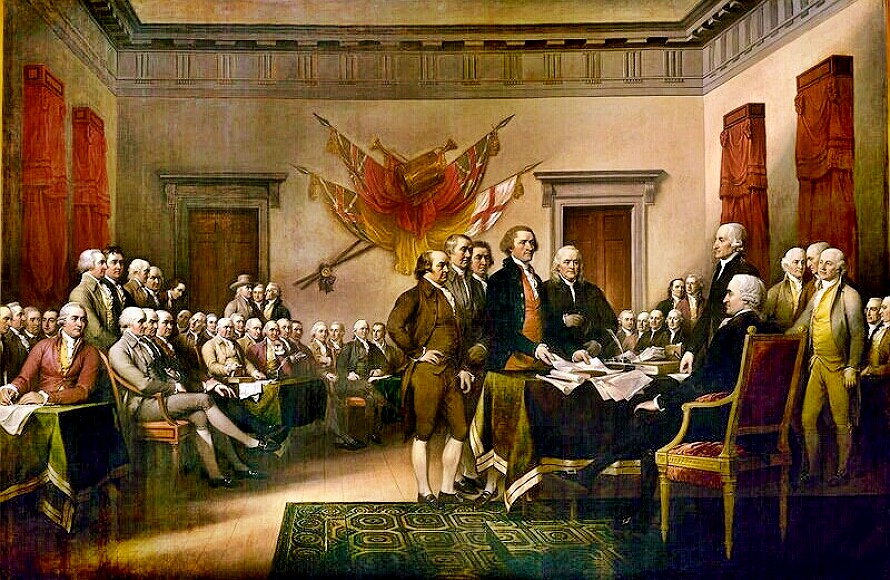
The historical evidence on this definition is not ambiguous. The Declaration of Independence (1776), whose principal author was Thomas Jefferson, of Welsh, English, and Scottish descent, articulated the philosophical basis of American self-governance: that all men are created equal, endowed by their Creator with unalienable rights, and that governments derive their just powers from the consent of the governed. The Constitution of the United States (1787) established the framework of republican self-government that has endured since its ratification: the separation of powers, the system of checks and balances, the federal structure, and the principle of judicial review.
The Bill of Rights (1791) codified individual liberties against government overreach, drawing explicitly from the English common law tradition codified in Sir William Blackstone's Commentaries on the Laws of England (1765–1769). The Federalist Papers (1787–1788), written by Alexander Hamilton, James Madison, and John Jay, provided the intellectual defense of the constitutional framework and remain to this day among the most consequential works of political philosophy produced on American soil. In Federalist No. 2, Jay himself described the American people as "a people descended from the same ancestors, speaking the same language, professing the same religion, attached to the same principles of government, very similar in their manners and customs." The Founders did not merely embody a shared heritage; they named it and defended it as the very basis of American unity.
These documents were not the products of physical labor. They were the intellectual and legal architecture within which every subsequent act of American life — economic, political, social — took place. They were created by men who were, by an overwhelming majority, of Anglo-Protestant heritage; this tradition, by the time of the founding, had absorbed not only English, Scottish, Welsh, and Irish stock, but also the French Huguenot and Dutch Protestant families, including the family of John Jay, who had been rooted in colonial New York for generations. That heritage is not incidental to what they created. It is the source of it.
The Anglo-Protestant Foundation of the American Founding
Samuel Huntington, the Harvard political scientist and author of Who Are We? The Challenges to America's National Identity (2004), stated the case with precision: "America's core culture has been and, at the moment, is still primarily the culture of seventeenth- and eighteenth-century settlers who founded American society. The central elements of that culture...include the Christian religion, Protestant values and moralism, a work ethic, the English language, British traditions of law, justice, and the limits of government power." The signatory record of the Declaration confirms his characterization precisely. Of the 56 signers of the Declaration of Independence, 38 were of English extraction, five Welsh, four Scottish, and eight Irish — meaning 55 of 56 were of British Isles origin, and 47 were of specifically English, Welsh, or Scottish descent. Only one, John Morton of Pennsylvania, was of Swedish ancestry. Furthermore, 48 of the 56 were born in the American colonies themselves, meaning the overwhelming majority were not immigrants at all but colonial-born Americans, predominantly of British heritage.
The English language became the common tongue of governance, law, and commerce not by accident but because the men who built American institutions were English-speaking. English common law, as systematized by Blackstone, became the legal tradition of the new republic because the men who wrote the Constitution had been educated in that tradition.
Max Weber documented the theological dimension of this heritage with precision in The Protestant Ethic and the Spirit of Capitalism (1905). Calvinist theology, Weber argued, held that worldly success in one's vocation, or Beruf, was a sign of divine election; this doctrine produced, over generations, the habits of disciplined labor, deferred gratification, and productive reinvestment that Weber identified as the spirit of capitalism. It was not coincidental that this spirit produced its most durable political expression in the New England colonies, where Puritan Calvinist theology was the dominant cultural force, and that the civic habits it engendered shaped the American conviction that the individual, not the state, was the primary unit of political and economic life, a conviction that the Founders encoded in the Constitution and that no subsequent wave of immigration had any part in creating.
D'Souza's Central Argument
What makes America exceptional, therefore, is not its demographic diversity but the founding ideas that the Anglo-Protestant tradition produced: individual liberty, limited government, free markets, and constitutional self-governance. This is the core of D'Souza's argument across both What's So Great About America (2002) and America: Imagine a World Without Her (2014). D'Souza extends this to its most powerful implication in the latter: "It was the American founding that established the principles that made possible the success of the Civil Rights Movement." The left's revisionist history is specifically designed to obscure this sequence of causation.
In What's So Great About America, D'Souza observes that immigrants "are walking refutations of cultural relativism" because they are "voting with their feet in favor of the new culture" that the settlers built. They did not bring that culture with them; they arrived to receive it as beneficiaries of a constitutional order they had no part in creating. The millions of immigrants who came to America's shores were drawn precisely by the promise of what the Founders had already established. To reassign credit for the architecture to the people who arrived because of it is not historical correction; it is historical inversion. For a fuller account of what the republic the Founders built has produced and why it remains worth defending, see my companion commentary, 8 Indisputable Reasons America Remains Exceptional, at marcialslaw.com.
The Left's Argument and Its Logical Flaw
D'Souza further observes that immigrants to America were expected to assimilate into the founding culture: to learn English, to embrace constitutional principles, to adopt the civic values of the republic. This expectation was itself an acknowledgment that there was a pre-existing culture to assimilate into, a culture established by the settlers and Founders that defined what America was. An immigrant who rejected that culture was not building America. An immigrant who embraced it was honoring what the Founders had built.
The left, nevertheless, marshals three principal claims in support of its argument that those very immigrants were the builders of the republic they were required to adopt. Each claim, examined against the evidence, collapses under the weight of its own logical confusion.
First, they cite Chinese laborers, who constituted the majority of the workforce that built the Central Pacific Railroad between 1863 and 1869. These men performed work of extraordinary physical difficulty and deserve the recognition they were long denied. Nevertheless, they built that railroad within a legal and governmental framework that predated their arrival on American soil by nearly a century. The right of way, the land grants, the corporate charters, the labor contracts, the courts that enforced those contracts. All of these were products of the constitutional republic that the Anglo-Protestant Founders had built. The Chinese laborers built a railroad. The Founders built the republic within which that railroad was possible.
Moreover, the Naturalization Act of 1790, passed by the very first Congress of the United States, restricted citizenship to "free white persons" of good character, which meant the Chinese workers who built the Central Pacific were legally barred from citizenship in the republic they were helping to expand. This exclusion stands as one of the founding order's most significant moral failures, and it was eventually corrected through the republic's own amendment processes. However, the fact of that exclusion is itself evidence that the foundational institutions existed prior to and independently of the Chinese contribution. They built within a structure that preceded them, governed them, and only later, through its own corrective mechanisms, extended to them its full promise.
Second, the proponents of the 1619 Project, led by New York Times journalist Nikole Hannah-Jones in August 2019, argue that the labor of enslaved Africans built America's economy, and that 1619, when the first enslaved Africans arrived in Virginia, rather than 1776, should be understood as America's true founding. This argument conflates economic production with institutional founding. That enslaved labor was morally wrong and economically significant is not in dispute.
The question of whether the men and women who performed that labor under compulsion thereby became the founders of America's constitutional order is a different question entirely, and the answer is plainly no. The Constitution, the Bill of Rights, the Declaration of Independence, the English common law tradition, the system of republican self-government — none of these originated with the enslaved population. They originated with the Anglo-Protestant settlers and Founders, many of whom held enslaved persons as property; a contradiction that the founding generation itself recognized, that Abraham Lincoln confronted, and that the nation ultimately resolved through the costliest war in its history.
Furthermore, Hannah-Jones advances a stronger structural claim: that slavery shaped the very development of American capitalism and democracy in ways that make 1619 a more honest founding date than 1776. Even granting that slavery influenced the development of Southern agriculture and Northern textile industries, the question of economic development is categorically distinct from the question of constitutional authorship. The Declaration of Independence, the Constitution, the Bill of Rights, and the common law tradition that underlies them were not written, debated, or ratified by enslaved persons. The 1619 Project's central logical error is to conflate influence on a nation's economic history with authorship of its founding political documents.
Third, the left points to the waves of Irish, Italian, Eastern European, and other ethnic immigrants who arrived in the late nineteenth and early twentieth centuries and built the industrial economy of modern America. These men and women built factories, laid rail, dug canals, and staffed hospitals. Their contributions were real and lasting. Nevertheless, they built within a republic whose foundational institutions — its Constitution, its courts, its currency, its language of law — had been established decades to a century before their arrival. They arrived because of the house. They did not build the house.
Why This Debate Matters Today
Victor Davis Hanson, the classicist and military historian at the Hoover Institution, has argued across multiple works, including The Dying Citizen (2021), that the deliberate erasure of America's Anglo-Protestant founding culture from the historical narrative serves a political agenda rather than a historical one. In Who Are We?, Huntington extended his argument beyond heritage to politics: the greatest threat to the founding culture came not from immigrants themselves, he argued, but from the American elite class — the politicians, academics, corporate leaders, and media figures who had adopted what he called a denationalized identity, indifferent to national borders, founding traditions, and the civic bonds that make a republic function. An elite class that has no attachment to its founding culture will not defend it; it will, instead, systematically dismantle the institutions and narratives that sustain it, under the guise of inclusion and progress.
The evidence of this dismantling is not abstract. In September 2020, President Donald Trump established the 1776 Commission by executive order, charging it with producing a report on the American founding and restoring its teaching in the nation's public schools. The Commission released its report on January 18, 2021. Two days later, on his first day in office, President Joseph Biden dissolved the Commission by executive order, and the report was withdrawn from the White House website the same day. Whatever one's political affiliation, the sequence is instructive: the first official act of a sitting president in the domain of American education was to eliminate the only federal commission devoted to the teaching of the republic's founding history.
My friends and American countrymen, the question of who built America is not merely a question about the past. It is a question about what America is, what principles it stands upon, and what its citizens are obligated to preserve. What the conservative argument insists upon is this: the Anglo-Protestant tradition existed, it produced the founding documents and institutions of the United States, it was the work of a specific group of settlers and Founders, and it cannot be preserved if it cannot be accurately named and honestly acknowledged. The answer that the left offers, namely that no specific group built America and that it was built by everyone who ever arrived on its shores, is not history at all; it is politics dressed as history, and its consequence is to leave Americans without a clear account of what they are defending when they defend their republic.
Recovering that account is within every citizen's power, and it begins with four specific obligations.
Every citizen who takes this argument seriously has four immediate obligations.
Read the primary sources. The Declaration of Independence, the Constitution, the Bill of Rights, and the Federalist Papers are not museum pieces; they are the operating documents of a republic that depends on an informed citizenry for its survival. The Library of Congress makes all of them freely available at loc.gov, and each can be read in a single afternoon. A citizen who has read these documents is immune to the most common forms of revisionism, because revisionism depends on ignorance of the originals.
Make the distinction. Whenever you encounter the claim that America is a "nation of immigrants," answer it with precision: America began as a society of settlers who created a constitutional republic, and the immigrants who followed built their lives within the institutions those settlers established. The distinction is not hostile to immigrants; it is honest about history. Huntington was correct that to collapse it is to stretch a partial truth into a misleading falsehood, and a citizen who permits that falsehood to go unchallenged in conversation has ceded ground that does not belong to the left to claim.
Engage your local school board. The 1619 Project's curricula have entered thousands of American classrooms with the deliberate intention of replacing the 1776 founding narrative. Attend a school board meeting, ask which founding history materials are being taught, and advocate for instruction centered on the founding documents and the men who produced them. The 1776 Commission's report, though withdrawn from the White House website on January 20, 2021, was preserved by the Internet Archive and republished by several civic organizations; a search for "1776 Commission Report" will locate it, and it provides a principled framework for what that instruction should contain.
Read further. Dinesh D'Souza's What's So Great About America, Samuel Huntington's Who Are We?, and Victor Davis Hanson's The Dying Citizen each develop the arguments in this commentary with the depth that a single essay cannot provide. A republic whose citizens read seriously is more resistant to deception than one whose citizens read only the headlines their opponents have written for them. My 8 Indisputable Reasons America Remains Exceptional, also at marcialslaw.com, extends that examination directly.
Long live the Republic of the United States of America!
Stay informed!
Join a community of engaged patriots passionate about liberty, good governance, and strengthening U.S.-Philippine relations. By subscribing to Marcial's Law, you’ll receive exclusive insights and updates on policies that shape the future of both nations. Be part of the conversation that challenges the status quo and advocates for a return to constitutional principles. Subscribe now and never miss a critical update!