I seek to empower people by giving them something to ponder.
By Marcial Bonifacio
10/24/26
My friends and countrymen, on the thirty-ninth day of the impeachment trial of Vice President Sara Duterte (about which I have written separately in The Case for the Conviction of Vice President Sara Duterte and The Empty Chairs That Could Acquit Sara Duterte), the House prosecution panel made the most consequential procedural decision of the entire proceeding: it withdrew three of the four articles of impeachment and staked the entire case on a single charge. That decision has generated fierce debate between the prosecution and the defense, and Filipino citizens who wish to evaluate the trial's outcome intelligently must understand both sides. What follows is an attempt to present each perspective fairly, with the documented statements of the principals themselves.
What Happened
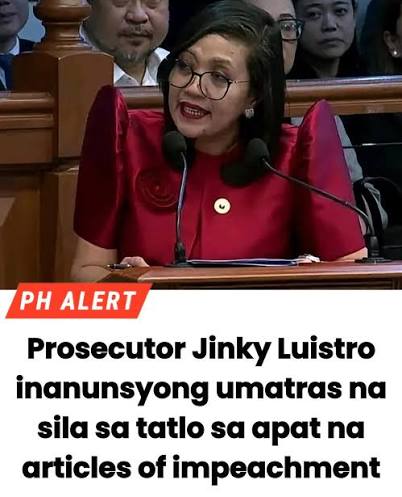
On October 13, 2026, House lead prosecutor and Batangas Representative Gerville Luistro announced before the Senate impeachment court that the prosecution would drop Article I (misuse of P612.5 million in confidential funds from the Office of the Vice President and the Department of Education), Article III (bribery of DepEd employees), and Article IV (grave threats and inciting to sedition against the President). Only Article II, covering unexplained wealth, false Statements of Assets, Liabilities and Net Worth, and continued business interests prohibited by the Constitution, would remain.
Luistro told the court: "Today, the prosecution respectfully manifests that it will no longer pursue three of them. It will stand on one, and that is Article 2 on unexplained wealth."
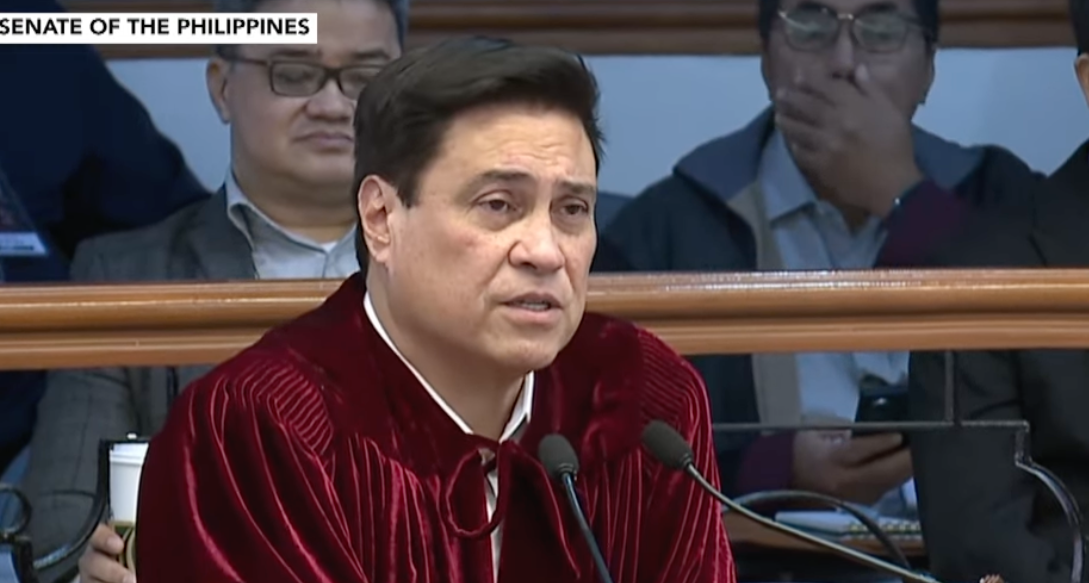
Presiding Officer Francis Escudero granted the motion, citing the precedent set during the 2012 impeachment trial of then Chief Justice Renato Corona, in which the prosecution withdrew five of eight articles and secured conviction on the remaining charges. Escudero also lifted the sub judice rule on the three withdrawn articles, meaning both sides may now discuss them publicly. He further ruled that Articles I and IV could no longer be refiled for the duration of the 20th Congress, or until the end of Duterte's term in June 2028. As of this writing, Escudero has not issued a separate ruling on whether the defense may present rebuttal evidence on the three withdrawn articles; that question remains a live point of contention before the court.
The Prosecution's Case for Dropping Three Articles
The prosecution advanced three principal arguments for narrowing the case.
The defense was planning to delay. Two prosecutors, Manila Third District Representative Joel Chua and prosecution spokesperson Benjamin Tolosa Jr., stated publicly that the prosecution dropped the three articles because it believed the defense intended to stretch the trial into 2027. Chua said the prosecution had "seen through their strategy." Tolosa added that the defense had "copied" the prosecution's own witness list during pretrial, signaling that it planned to call the same witnesses to relitigate every article. With four articles requiring separate witness presentations, cross-examinations, redirects, and re-crosses, the defense would have had months of procedural opportunities to stall.
Article II was the strongest charge. Chua stated plainly: "We picked the strongest article, or the strongest as the people think, because while we say that all articles are strong, the people said this has more weight." Prosecution spokesperson Ace Barbers separately called Article II the most compelling charge.
The evidentiary basis for this assessment was substantial. Forensic financial analyst Alexander Cabrera testified on Day 37 that Duterte and her husband, lawyer Manases Carpio, had P817.87 million in alleged undeclared assets and unexplained wealth from 2022 to 2025. The Anti-Money Laundering Council recorded P4.4 billion in covered and suspicious bank transactions involving the couple from 2007 to 2025. Cale88 Foods Corp., in which Carpio holds a 47.5 percent stake, received P319.33 million in remittances from mainland China and Hong Kong. BIR records showed that the couple's combined after-tax income from 2007 to 2025 was only P85.34 million, yet their undeclared financial footprint was many times larger.
This evidence came from independent government agencies (the AMLC, the BIR, the SEC, PhilGEPS, and the PNP Firearms and Explosives Office), not from political witnesses whose credibility could be attacked.
Conviction requires only one article. The prosecution only needs the senator-judges to convict on a single article to remove Duterte from office. Pursuing four articles when one is overwhelmingly documented and the other three would require weeks of additional witness presentations was, in the prosecution's judgment, an inefficient use of the trial's remaining time. Lead prosecutor Luistro cited the Corona impeachment as the governing precedent. Private prosecutor Chel Diokno added that the evidence against Duterte was based on "independent, verifiable facts."
The dropped articles are not lost. Luistro confirmed that the evidence already presented on the three withdrawn charges would be turned over to the Office of the Ombudsman for possible criminal prosecution. The prosecution is not abandoning those charges. It is routing them through a separate institution that operates on its own timeline, while concentrating the impeachment court on the charge most likely to produce a verdict before the political window closes.
The Defense's Case Against Dropping Three Articles
The defense raised objections that deserve equally serious consideration.
Due process and the risk of mistrial. Lead defense counsel Sheila Sison warned that allowing the prosecution to withdraw three articles after presenting evidence on them carried "the unmistakable characteristics" of a mistrial. Her argument was specific: the senator-judges had already heard prosecution witnesses on the confidential funds, grave threats, and bribery allegations. Those impressions now reside in the senator-judges' minds and cannot be unheard.
If the defense is barred from presenting rebuttal evidence on those articles, Duterte has been effectively accused without the opportunity to answer. Sison told the court directly: "The prosecution cannot make decisions for the respondent and the defense." She called the withdrawal "ridiculous" and "unacceptable."
Fairness cannot be sacrificed for speed. Sison later clarified that her principal objection concerned not the prosecution's right to withdraw (which she acknowledged as the House's prerogative) but the potential restrictions on the defense's ability to present evidence on allegations already aired before the court. As Sison stated: "This is not fairness." She warned that shortening the proceedings by limiting the defense's presentation of evidence could result in a mistrial, arguing that the desire to reach a verdict quickly should not come at the expense of due process.
No constitutional time limit on impeachment. Senator Alan Peter Cayetano stressed that the Constitution imposes no deadline on the conduct of an impeachment trial. He told the court: "It is our choice." The implication of this argument is that the prosecution's desire for speed should not override the respondent's right to a complete defense. If the evidence on all four articles was sufficient, then all four should have been pursued, regardless of how long the trial might take.
The prosecution's precedent does not precisely apply. Sison disputed the prosecution's reliance on the Corona impeachment. In that case, the prosecution withdrew five articles before the presentation of evidence. In Duterte's case, the prosecution withdrew three articles after presenting witnesses and evidence on at least two of them (the confidential funds and the grave threats). The procedural posture is different, and Sison argued that the Corona precedent does not authorize what amounts to a post-evidence withdrawal.
Duterte's own response. Vice President Duterte issued a public statement declaring that the prosecution dropped the bribery article because "they don't have evidence." She announced that she would never resign and declared her intention to run for president in 2028. She described the impeachment cases as "already failing" and said "all evidence is fabricated."
What Each Side Does Not Say
The prosecution does not openly state the political calculation behind its decision, though the logic is visible. The conviction threshold was reduced to 14 votes on Day 29, down from the standard 16 required when all 24 senator-judges are seated, after six minority senators refused to participate in that vote. Senator Robin Padilla has threatened to walk out of the trial entirely. The 2028 presidential election is approaching. Duterte maintains a 56 percent trust rating compared to President Marcos's 36 percent.
Every month the trial extends gives pro-Duterte forces more time to pressure wavering senator-judges, and every month brings the trial closer to campaign season, when conviction becomes exponentially harder to achieve. The prosecution's decision to narrow the case is, at least in part, a recognition that impeachment is a political proceeding conducted inside a political body, and political bodies are subject to pressures that courts are not.
The defense does not openly state the strategic advantage of a longer trial, though that advantage is equally visible. With four articles, the defense could call dozens of witnesses, file motions to exclude evidence, challenge document authenticity on each charge, request continuances, and raise procedural objections across a much wider front. Each of those steps consumes trial days.
The prosecution's own representatives admitted publicly that the defense had copied their witness list and appeared to have no independent witnesses to present. If that assessment is accurate, the defense's primary weapon was not evidence but time, and the prosecution's decision to narrow the case took that weapon away.
The American Parallel
Filipino voters who find this strategic narrowing unfamiliar should consider the second impeachment of President Donald Trump in January 2021. The House filed a single article of impeachment, incitement of insurrection, even though additional charges were available, because the political window was closing; President-elect Joseph Biden would be inaugurated on January 20, and a focused case offered the only realistic path to a Senate trial before that deadline. Trump's defense protested that the accelerated timeline denied adequate preparation and that the House had bypassed committee hearings; those objections mirror almost word for word the arguments of defense counsel Sison in the Duterte trial. The Senate ultimately acquitted Trump on a vote of 57 to 43, ten votes short of the two-thirds required for conviction. The underlying principle holds in both countries: when a legislature narrows its case to a single charge, it is making a judgment that focus and speed serve the public interest better than comprehensiveness, and that judgment carries both strategic advantages and constitutional risks.
The Question for Filipino Citizens
The central question is whether the prosecution's gamble serves justice or undermines it. The prosecution argues that a focused, swift conviction on the strongest charge is worth more than a comprehensive trial that risks never reaching a verdict. The defense argues that a trial in which the respondent cannot answer all the charges already aired is not a fair trial at all.
Both positions contain truth. A trial that never ends is not justice. A trial in which the accused cannot fully defend herself is not justice either.
The Senate impeachment court, by granting the prosecution's motion, has determined that the first risk outweighs the second. Whether that determination was correct will be judged not by legal commentators but by the senator-judges who must now render a verdict on a single question: Can Vice President Sara Duterte account for P817.87 million in alleged unexplained wealth?
My friends and countrymen, the prosecution has placed its bet. The defense will answer beginning November 9, and the court has set no formal verdict deadline, though the prosecution's stated urgency makes plain that proceedings cannot extend indefinitely without surrendering the political ground the narrowing was designed to protect. The evidence is now before the court, and the court is now before the people. Hold your senator-judges accountable. Demand that they judge on the evidence, not on political convenience. The Republic depends on it.
Long live the Philippines, and long live the Constitution that protects her!
Stay informed!
Join a community of engaged patriots passionate about liberty, good governance, and strengthening U.S.-Philippine relations. By subscribing to Marcial's Law, you’ll receive exclusive insights and updates on policies that shape the future of both nations. Be part of the conversation that challenges the status quo and advocates for a return to constitutional principles. Subscribe now and never miss a critical update!