I seek to empower people by giving them something to ponder.
By Marcial Bonifacio
9/17/26
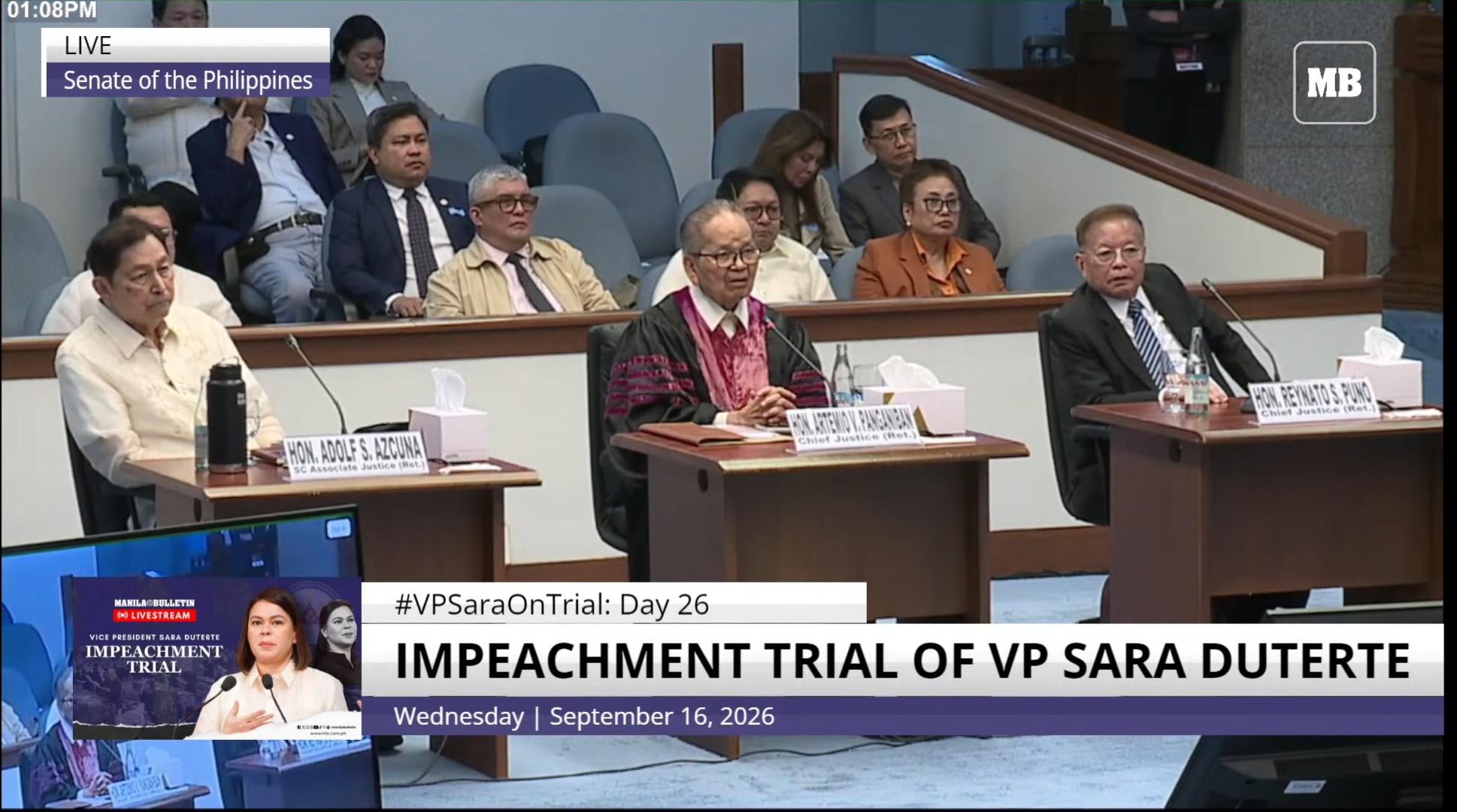
My friends and countrymen, the impeachment trial of Vice President Sara Duterte (about which I have written separately in The Case for the Conviction of Vice President Sara Duterte) has arrived at a constitutional crossroads. On September 16, 2026, the twenty-sixth day of trial, four retired Supreme Court justices appeared before the Senate impeachment court as amici curiae to address one question of profound consequence: Must sixteen votes remain the fixed and immutable threshold for conviction, or does the Constitution permit a flexible computation based on the number of senators who are actually qualified to participate? The answer to this question will determine not only the outcome of this trial but the meaning of impeachment itself in our Republic.
Two interpretations of the Constitution are now before the Senate impeachment court, and the distinction between them rests on a question as old as legal reasoning itself: Does one follow the literal words of the law, or the reason behind them? The first is the literal or fixed interpretation, grounded in the principle of verba legis, which holds that when the text of the law is clear, it must be applied as written without interpretation. Article XI, Section 3(6) requires the concurrence of two-thirds of all the members of the Senate, and "all the members" means the full twenty-four seats regardless of who occupies them, who is present, or who is legally capable of participating. Under this reading, sixteen votes are required for conviction under all circumstances. The second is the contextual or functional interpretation, grounded in the principle of ratio legis est anima, which holds that the reason of the law is its soul. The phrase "two-thirds of all the members" must be read alongside other constitutional provisions and practical realities, and the denominator must reflect the number of senators who are qualified and able to discharge their duties as judges, not the number of seats that nominally exist. Under this reading, the threshold adjusts to reflect the actual composition of the court. The question is whether the Senate impeachment court will follow the dead letter or the living purpose of the Constitution.
Filipino voters who find this debate unfamiliar should consider how our own Constitution was modeled. Article I, Section 3 of the United States Constitution provides that "no Person shall be convicted without the Concurrence of two thirds of the Members present." The critical word is "present." The American framers understood that a conviction threshold must account for the real composition of the body sitting in judgment, not an abstract number on a roster. The Philippine Constitution of 1987 uses the phrase "all the Members of the Senate" rather than "Members present," and it is precisely this difference in language that has produced the current dispute. However, three former chief justices of our Supreme Court have now concluded that the Philippine phrase, properly interpreted, does not require the rigid result that its critics claim. Indeed, Davide, who helped write the 1987 provision, testified that the Philippine framers intended the same functional result that the American framers achieved with the word "present": a senator who cannot participate in the trial cannot be counted toward the threshold for conviction.
Former Chief Justice Hilario Davide Jr., a framer of the 1987 Constitution, submitted a memorandum stating that the basis of computing the two-thirds must be the number of senators who are qualified to vote, "not the 24 in the present Senate." Davide specified that the framers of the 1935, 1973, and 1987 Constitutions could never have intended to include in the phrase "all the Members of the Senate" those who are outside the jurisdiction of the Philippines, whose whereabouts are unknown, who are in hiding to avoid arrest, or who suffer from legal impediments or restraints that render them incapable of exercising their duties. Davide's position is not without precedent in Philippine jurisprudence. In Avelino v. Cuenco (83 Phil. 17, 1949), the Supreme Court treated the Senate's effective membership as twenty-three instead of twenty-four because Senator Tomas Confesor was in the United States and beyond the Senate's ability to compel attendance, and Senator Vicente Sotto was confined on medical leave. The Court ruled that twelve senators constituted a valid majority of twenty-three. Although Davide himself noted that the Avelino case is "not directly applicable in impeachment cases" because it concerned quorum for ordinary legislative business, he concluded that by analogy it provides guiding light for the present question. The principle is the same: a senator who cannot be compelled to participate cannot be counted as though he had participated.
Former Chief Justice Reynato Puno rejected a standalone literal reading of Article XI, Section 3(6). He observed that if the framers had intended a fixed number, they would have written "sixteen" rather than employing a fraction. As Puno stated, "By using two-thirds, the number of votes to convict will have to move depending on certain factors," including which senators are legally and physically capable of participating. Puno further cautioned that wrongfully excluding a senator-judge from participating could expose the entire proceeding and any eventual verdict to Supreme Court review and possible nullification. This caution deserves honest acknowledgment, for it cuts in both directions. If the Senate wrongfully excludes a senator-judge who should have been counted, a conviction could be voided. If the Senate wrongfully includes a senator-judge who should have been excluded, an acquittal could be challenged on the same grounds. The solution is not to avoid the question but to answer it correctly, which is precisely why Puno advocated for what he called a "contextual and functional interpretation of the Constitution" rather than a mechanical recitation of the number twenty-four.
Former Chief Justice Artemio Panganiban described the impeachment trial as sui generis, possessing both legal and political character. He questioned whether it would be fair to allow senators who are traveling abroad or hiding "in the dark corners of the world" to participate in the final vote when others have spent their time hearing arguments and examining evidence. He urged senators who have failed to actively participate to consider inhibiting themselves from the proceedings. Panganiban also stressed that the threshold question is not for the Supreme Court to decide. It is for the Senate itself, as the sole judge of impeachment cases, to resolve. That distinction matters. The Senate is not waiting for permission. It is exercising a power that the Constitution exclusively confers upon it.
Retired Senior Associate Justice Antonio Carpio, though not among the four amici curiae who appeared on September 16, has independently and consistently argued the same position since before the trial began. Carpio maintained that the phrase "all members of the Senate" refers only to those who remain qualified to perform the functions of a senator, and he applied that principle to three specific cases: Senators Rodante Marcoleta and Jinggoy Estrada, both detained on separate plunder charges, and Senator Ronald dela Rosa, who never took the oath as a senator-judge. As Carpio stated plainly, "If you cannot hold office, you cannot vote." Under his computation, only twenty-one senators are presently qualified to be counted, which would reduce the two-thirds threshold to fourteen votes. The arithmetic is not arbitrary. It follows directly from the constitutional principle that membership requires the capacity to serve. The constitutional standard of two-thirds does not change. The fraction remains identical. Only the number of qualified members to whom the fraction applies changes.
The lone dissenter among the amici curiae was retired Associate Justice Adolfo Azcuna, who insisted that "all means all" and that the constitutionally mandated two-thirds vote must be computed on the basis of all twenty-four senators without exception. He argued that a threshold must be fixed and determinable from the start, not subject to adjustment depending on how many senators are present on any given day. Azcuna illustrated the concern with arithmetic: if only twenty senators were counted, two-thirds would amount to roughly thirteen or fourteen votes, substantially below sixteen. He concluded that such a reduction would undermine the very nature of a supermajority requirement. Presiding Officer Francis Escudero, in his July 6 ruling, adopted the same position, citing the Supreme Court's ruling in Bayan v. Zamora (2000), which held that despite only twenty-three incumbent senators at the time, the constitutional requirement still meant at least sixteen affirmative votes. However, Bayan v. Zamora concerned a vacant seat, not senators who are detained, in hiding, or legally incapacitated. A vacancy means no occupant exists. The present situation is fundamentally different: the occupants exist but cannot serve, which is the precise category that Davide, Puno, and Panganiban addressed in their opinions. It should also be noted that during the impeachment trial of President Joseph Estrada in 2000, there were only twenty-two sitting senators, and confusion arose among lawmakers over whether fifteen or sixteen votes were needed for conviction. Davide himself served as presiding officer of that trial, which ended not in a conviction vote but in a walkout by the prosecution and mass public protest that forced Estrada from office. The threshold question was never formally answered. It has been deferred, not resolved.
Justice Azcuna's position, while internally consistent, does not withstand scrutiny against the realities of the present Senate. Several senator-judges cannot regularly attend the proceedings: Senators Jinggoy Estrada and Rodante Marcoleta are detained on separate plunder charges, Senator Ronald dela Rosa has evaded public life amid an active International Criminal Court arrest warrant and never took the oath as a senator-judge, and Senator Loren Legarda is on extended medical leave abroad with no confirmed date of return. To count those absent or legally incapacitated senators in the denominator is to grant them a de facto vote against conviction without their ever hearing a single witness, examining a single document, or deliberating upon a single article of impeachment. The Constitution does not confer that power upon an empty chair. A fixed threshold of sixteen under such circumstances does not protect the integrity of the supermajority requirement. Quite to the contrary, it weaponizes absenteeism. Any faction seeking to shield an impeached official from conviction need only ensure that enough allied senators remain absent, detained, or beyond the jurisdiction of the Senate to make sixteen votes arithmetically impossible. That is not constitutional governance. That is constitutional sabotage.
Vice President Duterte's spokesperson, Salvador Paolo Panelo Jr., warned that lowering the sixteen-vote threshold could invite the sitting government to target senators expected to vote against its preferred outcome. This argument sounds reasonable in the abstract but collapses upon contact with the facts. The question before the impeachment court is not whether the government may target senators. The question is whether senators who are unable or unwilling to perform their constitutional duty as judges should nevertheless be counted as though they had performed it. If Panelo's concern is political interference, the remedy is to protect each senator-judge's independence, not to count non-participating senators in the denominator so that conviction becomes structurally impossible. Former Senator Richard Gordon has articulated a position that exposes the deeper problem with the defense's posture. As Gordon himself declared, "Hindi itinatakda ng Konstitusyon ang 16 na boto para sa paghatol sa impeachment," which translates to: the Constitution does not fix sixteen votes for conviction in impeachment. Gordon has also described Vice President Duterte as an official who behaves as though she is owed her standing in public life, yet the impeachment clause exists precisely to hold powerful officials to account. A conviction threshold that becomes unreachable due to the voluntary or involuntary absence of allied senators does not preserve the constitutional order. It dismantles it.
The contextual interpretation is the correct one, for four reasons. First, it reflects the stated intent of a framer of the Constitution itself. Davide did not speculate about what the framers might have intended. He told the Senate what they intended, because he was among those who wrote the provision. Second, it prevents the absurdity that Panganiban identified. If five senators were to die and three were to resign, leaving only sixteen members, the literal interpretation would require all sixteen remaining senators to vote for conviction, a unanimity requirement that no constitution in the world imposes for impeachment. Third, it prevents the manipulation that Puno warned against. A wrongful exclusion or a wrongful inclusion of a senator-judge in the count could expose the entire proceeding to Supreme Court nullification. The contextual interpretation, applied honestly, addresses that risk by requiring the Senate to determine the composition of its court based on legal qualification rather than political convenience. Fourth, it produces a concrete and defensible result when applied to the present Senate. Carpio has done the arithmetic that Azcuna warns against, and the arithmetic holds: three senators who are detained or who never took the oath as senator-judges cannot be counted among those qualified to vote, reducing the denominator to twenty-one and the threshold to fourteen. That is not a weakening of the supermajority requirement. It is the honest application of the supermajority requirement to the Senate as it actually exists.
The Senate impeachment court is not a legislature counting heads for a quorum. It is a constitutional tribunal sitting in judgment of the second highest official of the Republic. Its members must have heard the evidence, examined the witnesses, and deliberated upon the articles before casting their votes. To count senators who have done none of those things in the denominator is to make a mockery of the trial itself.
My friends and countrymen, the Senate must not surrender its own judgment to a mathematical fiction. The Constitution grants the Senate the sole power to try and decide all cases of impeachment. That power carries with it the duty to determine, honestly and without manipulation, who among its members is qualified to exercise it. The three former chief justices and Justice Carpio have shown the way. The Senate must follow. And we, the citizens who entrusted our sovereignty to these institutions, must hold every senator-judge accountable for the vote that is to come.
Long live the rule of law, and long live the Republic of the Philippines!
Stay informed!
Join a community of engaged patriots passionate about liberty, good governance, and strengthening U.S.-Philippine relations. By subscribing to Marcial's Law, you’ll receive exclusive insights and updates on policies that shape the future of both nations. Be part of the conversation that challenges the status quo and advocates for a return to constitutional principles. Subscribe now and never miss a critical update!