I seek to empower people by giving them something to ponder.
By Marcial Bonifacio
9/4/26
My friends and countrymen, the United States of America is once again fighting to keep the sea lanes open to honest commerce, and it is not the first time (as I have shown in 8 Indisputable Reasons America Remains Exceptional at 250) a president has had to make that choice without asking permission from the men who would strangle American trade for tribute.
The First Barbary War: Jefferson and the Precedent
In the final years of the eighteenth century, the regencies of Tripoli, Algiers, Tunis, and the Sultanate of Morocco routinely seized American merchant vessels in the Mediterranean, enslaved their crews, and demanded annual tribute payments from the United States government in exchange for safe passage. This was not metaphorical piracy. It was a documented, decades-long extortion racket conducted against American shipping, and previous administrations under Presidents George Washington and John Adams had paid it rather than fight it.
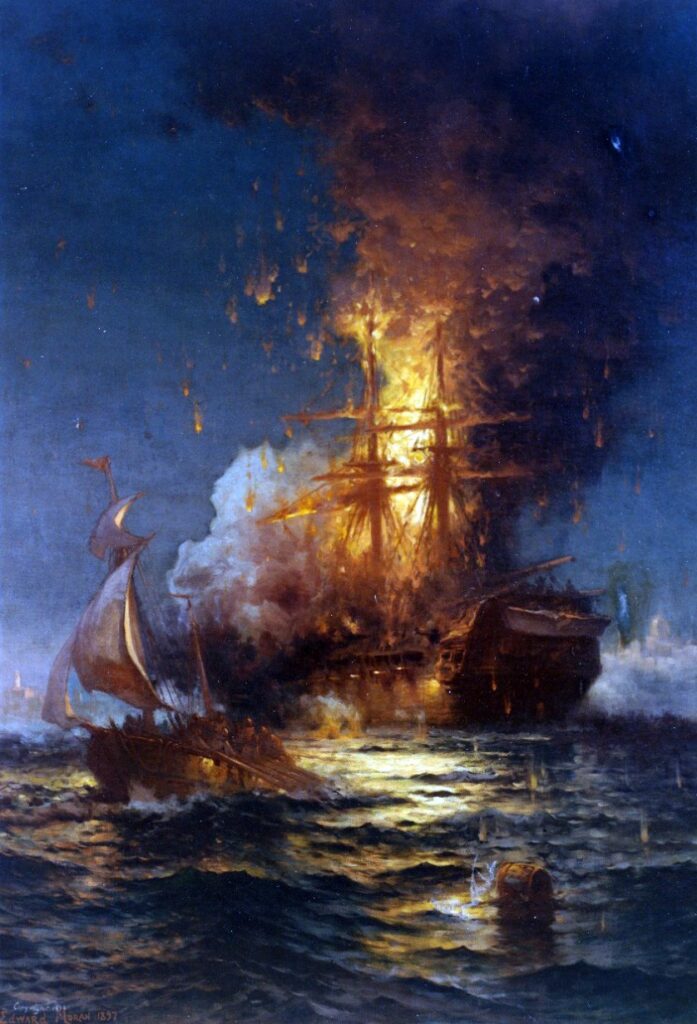
Thomas Jefferson, upon assuming the presidency in 1801, refused to continue the practice. When Tripoli's Pasha, Yusuf Karamanli, demanded an increased tribute and declared war on the United States after Jefferson would not pay it, Jefferson dispatched a small naval squadron to the Mediterranean under strictly defensive orders, without first seeking a formal declaration of war from Congress. When Congress convened that December, Jefferson reported what he had done and asked for expanded authority, telling the legislature that the pasha's ultimatum, in his words, "admitted but one answer." Congress answered on February 6, 1802, with the Act for the Protection of Commerce and Seamen of the United States against the Tripolitan Cruisers, a statute declaring it lawful for the president's commanders "to subdue, seize, and make prize" of Tripolitan vessels and goods. The resulting conflict, known as the First Barbary War, ran from 1801 to 1805. It included the burning of the captured USS Philadelphia in Tripoli harbor by Stephen Decatur's raiding party in February 1804. The Philadelphia was a thirty-six-gun frigate carrying twenty-eight eighteen-pounder cannon and sixteen thirty-two-pounder carronades, manned by a crew of three hundred and seven, and built only five years earlier as one of the newest warships in the American fleet. Had the Tripolitans been able to refit and sail her, they would have possessed the most heavily armed vessel in the Mediterranean theater, outgunning every ship in their own navy several times over. Decatur's raid denied them that capability permanently. The war also produced the overland march of a mixed force of United States Marines and mercenaries under William Eaton against the city of Derne in April 1805, an engagement commemorated in the Marine Corps hymn's reference to the shores of Tripoli. The war concluded with the Treaty of Tripoli, signed on June 4, 1805, which ended tribute payments to that regency and secured the release of American captives.
The Second Barbary War: What Happens When Enforcement Lapses
The history that followed proves Jefferson was right to fight rather than pay, because the moment enforcement lapsed, the tribute returned. While the United States was occupied fighting Britain in the War of 1812, the Dey of Algiers resumed seizing American merchant vessels and enslaving their crews, exactly as the Barbary regencies had done before Jefferson's war. When the War of 1812 ended, President James Madison sent Commodore Stephen Decatur back to the Mediterranean with a ten-ship squadron in May 1815. Decatur captured the Algerian flagship Meshouda, killed the corsair Raïs Hamidou in the engagement, and dictated peace terms in the Bay of Algiers on June 30, 1815. The treaty ended all tribute payments permanently and secured full shipping rights for American vessels. The entire campaign, from departure to signed treaty, lasted approximately six weeks. This was not a new war. It was the same war, fought a second time because the first resolution had not been enforced while America was looking elsewhere. Any reader who believes the United States can simply walk away from the Strait of Hormuz and expect Iran to stop collecting tribute should study what Algiers did the moment the American Navy sailed home. Iran has already demonstrated the same pattern: the April 8 ceasefire paused the fighting, and the Revolutionary Guard Corps resumed its toll regime the moment the truce collapsed in early July, exactly as the Dey of Algiers resumed seizing American ships the moment American attention turned to Britain.
Jefferson did not fight his war for territory, and he did not fight it to remake Tripoli's government. Madison did not fight his war to govern Algiers. Each fought for one narrow, nameable objective: the end of tribute. Once that objective was secured, the war ended. Neither Jefferson nor Madison would accept a peace that left a foreign power taxing American commerce by force, but neither confused that principle with a mandate for open-ended war.
The Parallel: Trump and the Strait of Hormuz
The current war against Iran did not begin over shipping. It began on February 28, 2026, when the United States and Israel carried out a preemptive strike on Iran's rapidly advancing nuclear and missile program along with its military leadership, killing Supreme Leader Ali Khamenei. Iran's retaliation arrived that same day: the Islamic Revolutionary Guard Corps warned all vessels over VHF radio that "no ship is allowed to pass the Strait of Hormuz," a waterway that had carried roughly a quarter of the world's seaborne oil trade before the war.
The path from there to renewed fighting was not a straight line to war, and readers skeptical of this conflict deserve to know that. Pakistan brokered an initial ceasefire on April 8, 2026, and mediation continued for months afterward. In mid-July, as the truce frayed, a further proposal reportedly floated by regional mediators would have let Iran collect what one source described as "reasonable service fees" for maritime security in the strait, in place of the unilateral, multimillion-dollar tolls the Revolutionary Guard Corps later imposed. That proposal did not hold. Iran's Foreign Ministry maintained it had no ongoing negotiations with Washington beyond talks with Oman over the strait itself, and President Trump, after a wave of Iranian strikes killed American service members in Jordan, dismissed further talks as a "waste of time." Whatever else is true of this war, it was not the first option reached for. It followed a real, if ultimately failed, diplomatic effort to reach the more modest arrangement Jefferson himself might have recognized: a paid right of passage negotiated rather than extracted at gunpoint. As of early September 2026, the situation has deteriorated further. On September 1, United States Central Command struck Iranian military targets around the strait, and on September 2, the United States struck two Iranian government tankers anchored off Iran's coast, the first reported case of tankers themselves being targeted. Iran retaliated with approximately twenty-five ballistic missiles and drone strikes against American-linked bases in Jordan, Bahrain, Kuwait, and Erbil. Strait transit volume has fallen to single digits per day against a pre-war baseline of eighty-five. Iran and Oman continue talks over navigation routes in the strait, and Qatar's Prime Minister visited Tehran in late August as part of ongoing mediation, but Iran's Foreign Ministry insists these discussions concern vessel routing, not reopening the waterway.
When the ceasefire collapsed and fighting resumed, President Trump notified Congress on July 10 that hostilities had resumed, and the fighting since has centered specifically on one demand: Iran's Revolutionary Guard Corps operates what it calls the Persian Gulf Strait Authority, charging commercial vessels tolls of up to two million dollars, payable in Chinese yuan, Bitcoin, or Tether, for passage through routes Iran alone designates as safe. Ships that refuse to pay, or that use routes Iran has not approved, have been fired upon and disabled, including three vessels attacked on July 6 and 7, 2026.
Set the two demands side by side and the parallel is exact. Karamanli told Jefferson: pay tribute in gold, or your ships will be seized and your sailors enslaved. The Revolutionary Guard Corps tells commercial shippers: pay toll in cryptocurrency, or your ships will be fired upon and disabled. Jefferson answered a demand for gold with the United States Navy. Trump has answered a demand for Bitcoin the same way, ordering sustained air operations against Iranian military assets after the July toll attacks, having already made his posture toward Tehran clear months earlier when he declared there would be "no deal with Iran except unconditional surrender." Two presidents, separated by more than two centuries, reached the identical conclusion: a nation that controls the world's shipping lanes does not rent its own strait back from whoever threatens to close it.
Answering Two Objections
Critics raise two serious objections, and both deserve a direct answer rather than a sidestep.
The first concerns whether this is truly a war on terror, or something narrower. The Barbary States were sovereign regencies engaged in piracy and slave-taking, not a state accused of directing proxy militias such as Hezbollah, the Houthis, and various Iraqi armed groups. The distinction is real, yet it does not undercut the tribute parallel, because the Barbary States were themselves acting with the implicit protection of the Ottoman Empire, using state ports and state-sanctioned violence to extract payment from nations they judged too weak to fight back. Iran's use of the Revolutionary Guard Corps to enforce its Hormuz tolls follows the same structure: force applied by a state actor, with just enough deniability to complicate a clean response. The tribute, in both cases, was never really about the money. It was about who controls the passage.
The second concerns whether this war was ever lawfully authorized. This objection demands careful engagement, because its premise is partly right and partly outdated. Jefferson secured explicit statutory authorization through the front door: he told Congress what he had done, and Congress answered with a named statute granting him expanded power. Trump has not received that kind of explicit authorization. That much is true, and no honest commentator should pretend otherwise.
What is also true, however, is that no president since Franklin Roosevelt has operated under a formal congressional declaration of war. President George H.W. Bush ordered the invasion of Panama and the overthrow of Manuel Noriega in 1989 under Article II authority alone. President Clinton sustained a seventy-eight-day bombing campaign against Serbia over Kosovo in 1999 without congressional authorization and in direct defiance of a House vote that declined to endorse the air war. President Obama directed a seven-month air campaign against Libya in 2011 under Article II, continuing well past the War Powers Resolution's sixty-day deadline while the Office of Legal Counsel argued the operation did not constitute "hostilities" within the meaning of the statute. In each case, Congress protested, and in each case, the president continued. The constitutional norm that critics invoke, a formal declaration of war before the first shot is fired, has not been operative in American governance for eighty-four years. Trump's Article II claim is not novel. It is the standard modern template, used by presidents of both parties, for military operations the executive branch deems necessary to protect American national interests abroad.
Moreover, the Trump administration has never conceded that it exceeded the War Powers Resolution's sixty-day limit. The White House argued in a May 1, 2026 letter to Congress that the April 7 ceasefire terminated the original hostilities and stopped the clock. When fighting resumed in July, the president's July 10 notification to Congress opened a fresh sixty-day window. Senate Democrats, including Adam Schiff, Chris Van Hollen, and Tammy Duckworth, have publicly rejected that reading, and both the House and Senate passed war powers resolutions in 2026 aimed at restricting the president's ability to continue the war. Van Hollen, sponsoring a war powers resolution in the Senate, argued the case for restraint by pointing out that shipping in the strait had "once again been ground to a halt." It is worth stating plainly, however, that Van Hollen's own description of the problem is precisely the condition Jefferson and Madison went to war to end: a strait ground to a halt by a foreign power extracting tribute from commercial shipping. If the senator's diagnosis is correct, the Jeffersonian prescription is not withdrawal. It is the opposite.
Those resolutions, however, were concurrent resolutions with no force of law. They did not go to the president's desk, and they could not compel withdrawal. Congress possesses a constitutional instrument that can end any war at any time: the power of the purse. It has not used it. On the contrary, House Republicans passed a ninety-five-billion-dollar funding package that included direct appropriations for the Iran war. A Congress that funds a war while passing symbolic resolutions against it has, in constitutional terms, chosen the check that carries actual legal force over the one that does not. Jefferson received a yes in the form of a named statute. Trump has received a yes in the form of a signed appropriation. The vehicles differ; the constitutional effect, the decision to resource rather than defund, is the same.
Furthermore, President Trump's own March 2 report to Congress specifically cited among its justifications "ensuring the free flow of maritime commerce through the Strait of Hormuz," the very principle this essay argues is at stake. The freedom-of-navigation case is therefore not an interpretation Marcial Bonifacio, your humble advocate, has imposed on the war from outside. It is the legal position the administration itself has filed with Congress.
In an ideal constitutional order, Congress would still do what the Congress of 1802 did: pass its own Act for the Protection of Commerce, naming the Strait of Hormuz mission and granting the president explicit, bounded authority to keep it open. That a politically fractured Congress has proven unable to do so does not strip the president of the authority that Article II, eighty-four years of bipartisan precedent, and a funded appropriation have already conferred. It means Congress has defaulted on its own responsibility, not that the president has exceeded his.
What the War Has Cost, What Victory Would Deliver, and What Jefferson Would Ask of Us Now
Jefferson did not know his war would succeed before he began it. The First Barbary War lasted four years, produced no single decisive victory, and required a young nation to sustain a naval presence across the Atlantic at real cost. He fought anyway, because he judged indefinite tribute the greater cost, and Congress, when finally asked, agreed with him. When the tribute ended, so did the war. He did not stay to govern Tripoli.
The current war has already exacted its own price. Secretary of Defense Pete Hegseth told the Senate Appropriations Committee on July 21, 2026, that the war has cost the United States thirty-seven and a half billion dollars to date, with experts warning the true bill will run higher. Eighteen American service members have died in connection with the conflict. Global oil prices have climbed past ninety dollars a barrel. Senator John Kennedy of Louisiana, describing the naval blockade's effect on Iranian oil exports, called the strategy "very effective," while Senator Tim Sheehy of Montana, a former Navy SEAL, told his Senate colleagues in late July 2026 that Iran's theocratic leadership constitutes a regime that must be neutralized, a judgment his Democratic colleagues on the same floor have directly disputed. Jefferson would not have waved these costs away. He buried sailors and spent money the young republic could not easily spare, and he did it anyway, because he judged that a nation which pays tribute once will be asked to pay it again, at a higher price, indefinitely. That same judgment, and not a comfortable certainty about how this war ends, is the actual case for seeing it through: not that the cost is small, but that the alternative, permanent submission to a toll collector in the strait, compounds rather than resolves it.
Skeptics who ask what victory would deliver in concrete terms deserve a concrete answer, because Jefferson's wars had clear endpoints and this one should too. The International Energy Agency has called the Hormuz closure the largest supply disruption in the history of the global oil market. Brent crude, which sat at seventy-two dollars a barrel on February 27, the day before the war began, surged past one hundred and twenty-six dollars at its peak in March, and every ceasefire announcement since has triggered an immediate drop of fourteen to twenty percent in global oil prices. The Kiel Institute for the World Economy estimated in March 2026 that the closure raised global energy prices by approximately five to eleven percent and food prices by three to five percent, driven by the cascade from oil through fertilizer costs to food production. The International Maritime Organization reported in April that twenty thousand mariners and two thousand ships were stranded in the Persian Gulf. These are not abstract strategic consequences. They are the grocery bill, the gas pump, and the heating invoice of every American household, and they will remain elevated for as long as Iran controls the strait.
Victory, in Jeffersonian terms, means an open Strait of Hormuz guaranteed by an enforceable agreement that permanently ends Iran's toll regime, restores unimpeded commercial passage, and brings global energy and food prices back toward the levels that prevailed before Iran closed the waterway. President Trump's own rhetoric has been broader than that, calling for "unconditional surrender" rather than a bounded treaty on a single issue, and this essay will not pretend that the two formulations are identical. The Jeffersonian precedent supports the narrower objective, not the wider one, and the case this essay makes is for the endpoint the precedent actually warrants. Jefferson's Treaty of Tripoli (1805) and Decatur's Treaty of Algiers (1815) are the models: a signed, enforceable document that ends the tribute, frees the passage, and allows the Navy to come home. Anything less invites the relapse of 1812.
Hence, the question Jefferson faced in 1801 is the same one worth asking plainly in 2026, without pretending the answer is free: does a nation that controls global trade have the standing to simply stop paying whoever threatens to interrupt it, even at a cost of eighteen lives and thirty-seven billion dollars and rising, or does it pay the toll and hope the demands do not grow? Jefferson chose the first answer, and his choice built the credibility that made the United States Navy the guarantor of freedom of navigation for two centuries afterward.
Whether this war built anything comparable is not yet settled, and will not be settled by this essay. However, the principle he established, that the United States does not pay tribute to sail its own trade routes, is the same principle now being tested in the Strait of Hormuz. Will this generation of Americans decide, as Jefferson's did, that the price of resolve is worth paying, bounded to its purpose and funded by a Congress that has voted with its wallet whether it admits so or not, rather than the price of tribute? My friends and countrymen, a nation that would not pay a pirate a single coin in 1805 should not pay a regime a single Bitcoin in 2026.
Long live the spirit of Presidents Thomas Jefferson, James Madison, and Donald Trump! Long live the USA!
Stay informed!
Join a community of engaged patriots passionate about liberty, good governance, and strengthening U.S.-Philippine relations. By subscribing to Marcial's Law, you’ll receive exclusive insights and updates on policies that shape the future of both nations. Be part of the conversation that challenges the status quo and advocates for a return to constitutional principles. Subscribe now and never miss a critical update!