I seek to empower people by giving them something to ponder.
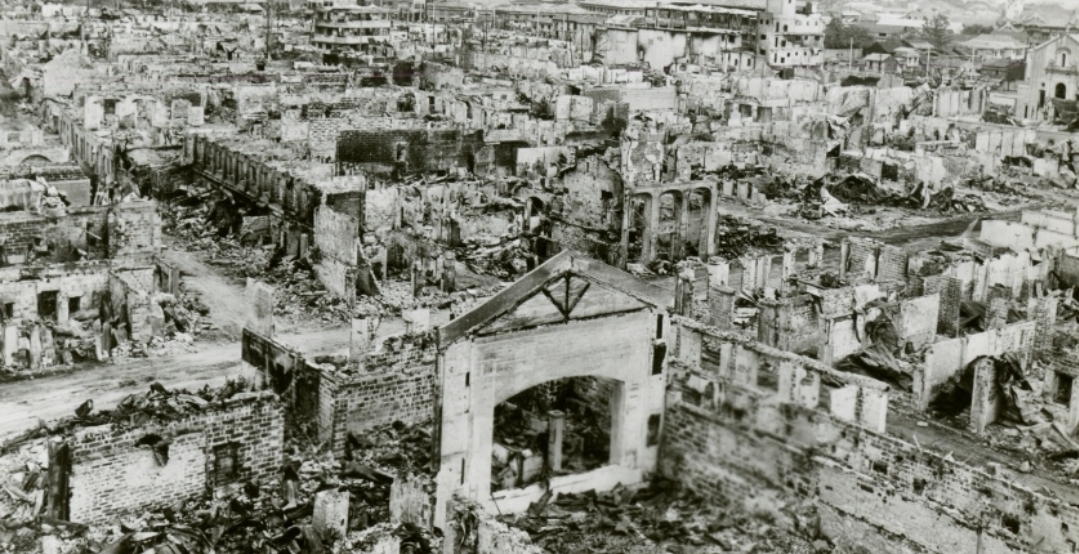
(Cover Photo: Manila After Bombing,1945, Old Photo Gallery)
By Marcial Bonifacio
11/2/26
My friends and countrymen, the civilian suffering in Gaza is real, and every death in war is a human tragedy that military doctrine and the law of armed conflict exist to prevent. It is precisely because that suffering is real that the legal charge built upon it deserves to be evaluated not by emotion but by evidence: the charge of genocide leveled against Israel in its war against Hamas, upon careful examination of that evidence, stands as one of the most unfounded accusations in the history of modern armed conflict. The charge is serious enough to deserve a thorough answer, and what follows provides one.
To evaluate it honestly, one must begin not with opinion but with law: Article II of the Convention on the Prevention and Punishment of the Crime of Genocide, adopted by the United Nations General Assembly on December 9, 1948, defines genocide as acts committed with the intent to destroy, in whole or in part, a national, ethnical, racial, or religious group.
Intent is not incidental to this definition. It is its indispensable legal foundation: what international law calls dolus specialis, or specific criminal intent. Without demonstrated intent to annihilate a people as a people, no military operation, however destructive in its consequences, constitutes genocide under international law.
One party to this conflict, however, has such intent on written record. Article 7 of the Hamas Covenant, published August 18, 1988, and available in full through the Yale Law School's Avalon Project, quotes a Hadith declaring that "the Day of Judgement will not come about until Muslims fight the Jews," and proceeds to specify that Jews must be killed wherever they hide. A revised Hamas document issued in 2017 softened some of this language but did not formally revoke the 1988 Covenant, and the massacres of October 7, 2023, in which Hamas killed over 1,200 Israeli civilians, confirmed which document governs Hamas's actual conduct. The burden of the genocide accusation, properly applied, falls there.
Israel's declared military objective, stated by Prime Minister Benjamin Netanyahu and confirmed in Israel's submissions to the International Court of Justice, was the destruction of Hamas as a military organization and the recovery of the hostages taken on October 7, 2023. An army cannot simultaneously declare its target to be a terrorist organization and be committing genocide against the civilian population that organization governs. Consequently, the stated war aim and the genocide charge are, by the very definition of dolus specialis, legally incompatible.
That intent is further contradicted by Israel's publicly declared vision for Gaza after the conflict. In January 2024, Defense Minister Yoav Gallant presented the first formal Israeli plan for post-war Gaza governance, stating explicitly that "Hamas will not govern Gaza" and that "Israel will not govern Gaza's civilians," with Palestinian civil committees assuming the territory's civilian administration. Prime Minister Netanyahu similarly stated that a civilian government, not Israel, should rule Gaza after the war. A state prosecuting genocide does not simultaneously plan the civilian governance of the population it intends to destroy.
The question of intent demands evidence, and evidence is precisely what retired Army Major John Spencer has spent the past three years systematically compiling. Spencer subsequently served as a Colonel in the California State Guard and currently chairs the urban warfare studies program at the Modern War Institute at West Point. He completed two combat tours in Iraq as a platoon leader and company commander, and his field research on the Gaza conflict includes direct observation in Israel and Gaza. Spencer holds no political appointment and carries no institutional interest in the outcome of this war.
He is the most credentialed urban warfare scholar in America, and his conclusion, drawn from his January 31, 2024, Newsweek article titled "Israel Implemented More Measures to Prevent Civilian Casualties Than Any Other Nation in History," is stated plainly: "Israel has implemented more measures to prevent civilian casualties than any other military in the history of war."
To understand the weight of that statement, one must examine the historical parallel that Spencer himself has identified as the most instructive comparison to Israel's operations in Gaza: the 1945 Battle of Manila. For Filipino readers, this is not a foreign analogy drawn from distant archives but their own history, the memory of a city that numbered among the most devastated capitals of the entire Second World War and a civilian population that suffered not incidentally but deliberately at the hands of an occupying force that turned the city into a battlefield. I, your humble advocate for the rule of law, have examined the full scope of that alliance in a separate commentary, The Full Ledger: Why America Remains the Philippines' Greatest Ally; the Battle of Manila belongs to that larger story. The month-long battle, fought from February 3 to March 3, 1945, was the fiercest urban combat of the entire Pacific War. Manila had a population of 1.1 million residents and held over 1,000 American prisoners of war within its limits.
The Japanese fortified buildings and tunneled to connect them via their basements, just as Hamas has used the urban infrastructure of Gaza. They used the Philippine General Hospital as a military stronghold in direct violation of the Geneva and Hague Conventions, in the same manner that Hamas has militarized hospitals in Gaza.
Article 19 of the Fourth Geneva Convention of 1949 is unambiguous on this point: when a defending force uses a protected site to commit acts harmful to the enemy, that site forfeits its protected status, and legal and moral responsibility for any resulting casualties transfers to the defending force, not the attacker.
Beyond the hospitals, the Japanese deliberately executed tens of thousands of Filipino civilians, not as collateral damage in combat, but as a calculated act of reprisal against a population they held responsible for welcoming the Americans.
The critical parallel Spencer draws between Manila and Gaza is the deliberate restraint each attacking army exercised in its use of lethal force. Gen. Douglas MacArthur forbade air strikes over Manila entirely, on the grounds that such strikes would inevitably kill large numbers of civilians and that while they might speed the conclusion of operations and save American soldiers' lives, he would not permit their use. He additionally restricted unobserved artillery fire. The result was grinding, month-long, house-to-house combat that cost the American XIV Corps over 1,000 soldiers killed and 5,500 wounded.
The Israel Defense Forces applied the same principle in Gaza. Spencer's account of IDF precautionary measures includes altered rules of engagement, restricted fire lines, no-fire areas around protected structures, and release authority requirements for strikes.
Furthermore, the IDF deployed an unprecedented civilian notification system: leaflets, millions of direct phone calls to residents, text messages, and drones equipped with loudspeakers warning civilians of impending operations and directing them to evacuation routes. As a consequence, before the heaviest fighting commenced in Northern Gaza, the IDF evacuated over 850,000 civilians, between 85 and 90 percent of the area's resident population.
Critics have raised the +972 Magazine report claiming Israel used AI targeting systems with minimal human oversight and pre-approved civilian casualty thresholds. That report was based entirely on anonymous sources and was formally and specifically denied by the IDF. AI decision-support systems are used by every major military in the world, including the United States and NATO allies; their existence alone establishes nothing about genocidal intent.
The dispositive legal question is what the systems were designed to target. A system designed to identify Hamas operatives, that is, individuals with specific military connections to a specific terrorist organization, is evidence of intent to destroy Hamas. On the contrary, a system intended to destroy Palestinians as a people would identify group membership, not organizational affiliation. An AI system that generates target lists based on organizational affiliation with Hamas is evidence of intent to destroy Hamas, not of intent to destroy Palestinians as a people.
Throughout the conflict, Israel also maintained humanitarian aid deliveries to Gaza through the Kerem Shalom crossing, keeping it open for the transfer of food, medicine, and fuel even as Hamas directed rocket fire at the crossing and at the soldiers operating it. The UN Office for the Coordination of Humanitarian Affairs reported that 83 percent of planned aid deliveries were blocked in the year following October 7. Israel disputes this figure and its methodology, and the dispute primarily concerns attribution: UN OCHA itself documented Hamas's systematic diversion of aid for military purposes, meaning aid that did not reach civilians was not blocked at the crossing but seized by Hamas after entry. Even accepting the disputed figure, the legal question under Article II(c) of the Genocide Convention is not whether aid was insufficient but whether Israel deliberately inflicted conditions calculated to bring about the group's destruction. A state genuinely pursuing genocide through starvation does not maintain aid crossings at any level, does not keep them open under rocket fire that kills its own soldiers, and does not, as Israel did, continue supplying electricity to Gaza from its own power plants throughout the conflict.
When the IDF's precautionary measures fail, moreover, accountability follows. The April 2024 strike that killed seven World Central Kitchen aid workers traveling in clearly marked vehicles on a pre-coordinated route was immediately acknowledged by Israel as an error. An investigation followed. A brigade commander and a colonel were dismissed. Additional officers were reprimanded. A state with intent to kill protected persons does not investigate and publicly discipline its own military officers for killing them. Errors resulting from negligence in an individual strike may constitute war crimes in that specific instance. They do not constitute genocide, which requires specific intent to destroy a group as a group applied systematically at the institutional level. The accountability that followed the WCK strike contradicted rather than confirmed any such intent.
The casualty figures then complete the comparison. In the 1945 Battle of Manila, the American military killed approximately 100,000 civilians in the course of destroying approximately 17,000 Japanese defenders. Israel has produced a lower civilian-to-combatant ratio in Gaza than the United States produced in Manila, where that ratio stood at six civilians for every one combatant killed, a standard against which America has never faced a genocide charge.
Critics argue that this ratio is artificially deflated because Israel classifies military-age males as combatants by default. This assertion is unsupported by IDF operational orders and rests almost entirely on casualty figures produced by the Hamas-controlled Gaza Health Ministry, which does not disaggregate combatants from civilians by any verifiable independent methodology. In fact, the arithmetic holds even under the critics' own figures. The United Nations has estimated approximately 70 percent of those killed in Gaza were civilians. Applying that figure to the most widely cited total death count of approximately 44,000 yields approximately 30,800 civilian deaths and 13,200 combatant deaths: a ratio of one combatant to 2.3 civilians, well below Mosul's ratio of one combatant to 2.5 civilians and far below Manila's benchmark of one combatant to six civilians.
Even if the civilian proportion is extended to 80 percent, representing the upper range of critics' estimates, the resulting ratio of one combatant to four civilians remains below Manila's standard. Only at a civilian proportion of 90 percent or higher does the ratio approach Manila's level, and that figure exceeds the estimates of every major institution, including those most critical of Israel's conduct. As a result, the comparison holds under every methodologically defensible set of numbers. The primary cause of the Manila civilian deaths was not American firepower but Japanese deliberate targeting of the Manileño population, a fact that bears directly on how responsibility for civilian death is assigned in both battles.
Spencer further documents that in the 2016–2017 Battle of Mosul, the largest urban battle since World War II, the U.S.-led coalition killed 10,000 civilians to destroy 4,000 ISIS fighters, a ratio of one combatant to 2.5 civilians. Manila's ratio was one combatant to six civilians.
Spencer's March 2024 analysis published in Newsweek established that Israel's ratio in Gaza stood at approximately 1.5 civilians killed for every combatant, a figure he described as historically low for modern urban warfare and one that falls below both of those American precedents.
This finding draws independent corroboration from Peter R. Mansoor, retired Army colonel and professor of military history at Ohio State University, whose analysis titled "A Not-So-Distant Mirror: What the Battle of Manila During World War II Suggests About Urban Combat, War Crimes, and the Battle for Gaza," published in Strategika, the journal of the Hoover Institution, drew the same Manila-Gaza parallel and found that, by historical comparison, Israel does not come out looking worse.
That judgment does not come from Israeli government spokesmen. It comes, after all, from two of America's foremost military historians, writing independently of each other.
An army's documented precautions against civilian harm constitute direct legal evidence of the absence of genocidal intent. Genocidal intent and systematic civilian protection are logically incompatible. No army that warns the civilians of a city before it fires, evacuates hundreds of thousands of civilians before it fights, and restricts its own lethal capabilities to its soldiers' detriment can simultaneously be acting with the specific intent to destroy those civilians as a people. That case has now been made on the evidence. Thus, the strongest remaining objections deserve equally direct answers.
Critics who acknowledge these ratios often pivot to the argument of scale: that the total number of Palestinian deaths, the extent of infrastructure destruction, and the conditions prevailing in Gaza constitute proof of genocidal intent regardless of the combatant-to-civilian ratio.
This argument confuses the legal standard with a numerical threshold that does not exist in the Genocide Convention. Article II of that Convention does not establish a minimum body count; it establishes an intent requirement. The relevant legal question, therefore, is not how many people have died but whether the army responsible for those deaths acted with the specific intent to destroy a people as a people.
A legally informed skeptic will go further and cite Article II(c) of the Convention, which prohibits deliberately inflicting on a group conditions of life calculated to bring about its physical destruction. This is the legal foundation of the siege and blockade argument. The answer is the same as the answer to the killing provision: Article II(c) requires the identical dolus specialis. Israel's maintenance of humanitarian aid crossings throughout the conflict and the full catalogue of precautionary measures Spencer has documented are incompatible with a deliberate policy of destruction through deprivation. The word "deliberately" in Article II(c) performs the same legal function as the word "intent" in Article II(a): it requires a state of mind that the IDF's operational conduct systematically contradicts.
Perhaps the most legally sophisticated version of the scale argument holds that genocidal intent need not be proven by direct evidence but may be inferred from a systematic pattern of conduct. The International Criminal Tribunal for the former Yugoslavia established this principle in Prosecutor v. Krstić, Appeal Chamber Judgment of April 19, 2004, and it has been applied only where the pattern involved mass graves, systematic execution of identified group members by reason of group membership, and deliberate destruction of cultural identity, as in Srebrenica and Rwanda. The pattern in Gaza includes the IDF's documented precautionary measures, its evacuation of 850,000 civilians before combat, and its unprecedented notification systems. Those precautions are conduct too, and they point in the opposite direction from the inference critics seek. A force with intent to destroy Palestinians as a people does not systematically protect them from combat operations.
By the only standard the Convention recognizes, the evidence points in one direction: the IDF warned civilians before strikes, restricted its own weapons, evacuated the population before combat, and produced a civilian-to-combatant ratio lower than the United States achieved in both Manila and Mosul.
Hamas, by contrast, has fired more than 13,000 rockets, missiles, and drones at Israeli civilian centers since October 7, 2023, every one of which constitutes a violation of the law of war, and every one of which was aimed not at military targets but at men, women, and children in their homes and cities. By every standard the international community has applied to armed conflict since 1945, the conduct of the party bearing documented genocidal intent in this war is Hamas, not Israel.
Critics who find this evidence insufficient often retreat to a broader historical argument. The Genocide Convention, however, is specific in its temporal and legal scope. It applies to acts committed with the defined intent at a defined time. It does not establish liability for historical political disputes, prior military conflicts, or decades-old policies, however contested those may be. Critics who invoke the 2007 blockade, the 1948 displacement, or the broader history of the conflict as evidence of genocide are conflating legitimate political grievances with a specific legal standard the Convention does not permit them to satisfy by historical accumulation. The question before any honest tribunal is not what happened in 1948 but what intent governed Israel's conduct beginning in October 2023, and that question must be answered by evidence, not by history.
The most emotionally charged counter-argument is not statistical but personal: that statements made by Israeli officials in the immediate aftermath of October 7, 2023, most notably Defense Minister Yoav Gallant's declaration that "We are fighting human animals and we are acting accordingly," constitute direct evidence of genocidal intent at the state level.
International law draws a precise and well-established distinction between inflammatory rhetoric from individual officials and the demonstrated institutional policy of a state. State genocidal intent, as established through decades of international tribunal jurisprudence including the judgments arising from the Srebrenica massacre, must be inferred from state policy and operational conduct, not from isolated statements made in the immediate aftermath of the largest massacre of Jewish people since the Holocaust.
Israel's official submissions to the International Court of Justice documented that its state policy, its military operational orders, and its government communications consistently framed the conflict as directed against Hamas as a terrorist organization, not against Palestinians as a people. Gallant was subsequently removed as Defense Minister by Prime Minister Netanyahu, further undermining any claim that his statement represented enduring Israeli state policy.
The case of Finance Minister Bezalel Smotrich carries the same legal argument even further, and by its own logic discredits the charge more thoroughly than Gallant's statement ever could. Smotrich, leader of the far-right Religious Zionist Party, made a series of statements that critics have rightly condemned as indefensible: a March 2023 call for the Palestinian village of Huwara to be wiped out, a declaration in Paris that same month that there is no such thing as the Palestinian people, and a May 2024 call for total annihilation in Gaza. These statements cannot be rehabilitated by context. They should not be defended.
They were not defended. Netanyahu's government condemned the Huwara remarks and moved immediately to distance itself from them. The United States administration described them as repugnant and formally urged Netanyahu to publicly reject and disavow them. The United Nations, Egypt, and Saudi Arabia condemned them. French government officials and major French Jewish organizations refused to meet with Smotrich during his Paris visit precisely because of them. Haaretz, Israel's leading newspaper, published an editorial calling for his dismissal over the Gaza statements.
Smotrich is not a moderate voice who briefly exceeded appropriate limits. He is the leader of a fringe far-right party whose positions are, by the assessment of Israeli analysts themselves, in direct opposition to the views held by the Israeli mainstream, including those on the nationalist right. He holds no position in the military command structure of the Israel Defense Forces. He does not set rules of engagement. He does not direct strikes. He does not command soldiers in the field. That a coalition government in a functioning democracy contains a minister whose statements his own coalition, his Western allies, and the international community have uniformly condemned is evidence of the difficulties of democratic coalition politics, not of a state pursuing genocide.
The most prominent objection in this category, however, concerns not a minister but the head of government himself. On October 28, 2023, Netanyahu, in an address to soldiers preparing for the ground invasion, invoked the biblical Amalek: "You must remember what Amalek has done to you, says our Holy Bible. And we do remember, and we fight." Critics cited this as genocidal intent at the highest level of command. The rebuttal is both contextual and structural. Contextually, "Amalek" functions in Jewish political discourse as a longstanding metaphor for existential enemies, applied across history to the Romans, the Nazis, and the Soviets, and Netanyahu's own office clarified that the reference concerned Hamas and its October 7 attacks specifically. One of his advisers confirmed the term functions as a stand-in for existential threat. Structurally, the Amalek reference is not an operational order. It specifies no targets, no methods, and no rules of engagement. The instruments that specify all three, namely the IDF's actual rules of engagement, strike authorization protocols, restricted fire lines, and evacuation procedures documented by Spencer, contain no such language and directly contradict any genocidal reading of the speech. Political rhetoric and battlefield command are distinct categories in both practice and law, and international tribunals have consistently required evidence of the latter to establish genocidal intent.
Individual inflammatory rhetoric, however reprehensible, has never been held sufficient in any genocide conviction to establish the dolus specialis required for a finding of genocide. It is the army's operational conduct that establishes intent: the evacuations, the notification systems, the restricted fire lines, the humanitarian crossings kept open under rocket fire. Statements made by fringe officials or in political heat by leaders whose words are not operational orders are not the evidence that settles a genocide case. If they were, the fact that those same statements were immediately and publicly condemned by Israel's own government would settle it in Israel's favor.
Skeptics regularly cite two institutional findings as validation of the genocide charge: the January 26, 2024, provisional measures ruling of the International Court of Justice in South Africa v. Israel, and Amnesty International's December 2024 report explicitly concluding that Israel is committing genocide. Both deserve direct examination.
The ICJ ruling has been consistently mischaracterized. The Court did not find that genocide was occurring. It did not order a ceasefire. It applied the procedural threshold of plausibility required to justify interim protective measures pending a full hearing on the merits: a standard so low that it requires only a demonstration that the claim is not frivolous, not that it is likely to succeed, and certainly not that it has been proven. The Court's order confirmed that its finding went to whether South Africa's asserted rights were plausible, not to whether genocide had been established as a matter of fact. The final ruling on the merits will require years of full legal proceedings. A finding that a legal claim survives initial scrutiny is not a finding of fact on that claim's substance. It is, by the Court's own design, the beginning of a legal proceeding, not its conclusion.
Amnesty International is an advocacy organization, not an international legal tribunal, and it does not possess the authority under international law to make binding genocide determinations. That authority rests exclusively with the International Court of Justice and the International Criminal Court. Amnesty's conclusion rests on the same pattern-of-conduct inference this essay has addressed and rebutted on the evidence: the IDF's documented precautionary measures are themselves part of the pattern, and they point in the opposite direction from the inference Amnesty draws. Spencer, whose field observation of the Gaza conflict is direct and documented, co-authored a December 2024 Newsweek opinion piece with Arsen Ostrovsky, international human rights lawyer and CEO of the International Legal Forum, describing Amnesty's conclusion as "no less than a blood libel." Mansoor's independent analysis appeared in the Hoover Institution's journal. When these authorities are weighed against an advocacy organization making a legal determination it has no jurisdictional authority to render, the weight of evidence does not favor Amnesty.
The case rests, finally, not on what advocacy organizations conclude or on what courts have yet to rule, but on what the record shows. That record speaks clearly.
Taken in its totality, the evidence points in one direction. The law requires specific intent to destroy a group as a group. Israel declared its objective to be the destruction of Hamas, not Palestinians. Its army warned civilians, evacuated populations, restricted its own weapons, and produced casualty ratios lower than those the United States produced in battles no court has ever classified as genocide. Its government condemned the most extreme statements made by its own officials. Its aid crossings remained open under fire. Its post-war governance plan explicitly provides for Palestinian civilian administration of Gaza, not Israeli occupation or the displacement of the Palestinian people. The party in this conflict with documented, written, institutionalized genocidal intent directed at a specific people is Hamas, whose Covenant calls for the killing of Jews wherever they hide and whose October 7 attacks were the largest massacre of Jewish people since the Holocaust. The evidence does not merely fail to establish Israeli genocidal intent. Quite to the contrary, it affirmatively establishes its absence.
My friends and countrymen, the question before any honest inquirer is not whether civilians have died in Gaza, for they have, and every civilian death in war is a tragedy that military doctrine and the law of armed conflict exist to prevent. The question is whether those deaths reflect an intent to destroy the Palestinian people as a people, or whether they reflect the documented consequence of urban warfare against an enemy that deliberately embeds itself among the civilian population it claims to defend.
Retired Army Major John Spencer, who has studied every major urban battle in modern military history and visited the battlefield firsthand, has answered that question. By the standard set by the United States itself in Manila in 1945, Israel has not committed genocide. It has exercised greater restraint than America did in a war the world has universally recognized as just. The verdict of history, rendered by America's own military record, is unambiguous. Which army, then, deserves the charge of genocide: the one that warns before it fires, or the one that fires without warning at the innocent?
Long live the rule of law, and long live the state of Israel!
Stay informed!
Join a community of engaged patriots passionate about liberty, good governance, and strengthening U.S.-Philippine relations. By subscribing to Marcial's Law, you’ll receive exclusive insights and updates on policies that shape the future of both nations. Be part of the conversation that challenges the status quo and advocates for a return to constitutional principles. Subscribe now and never miss a critical update!