I seek to empower people by giving them something to ponder.
By Marcial Bonifacio
6/30/2026
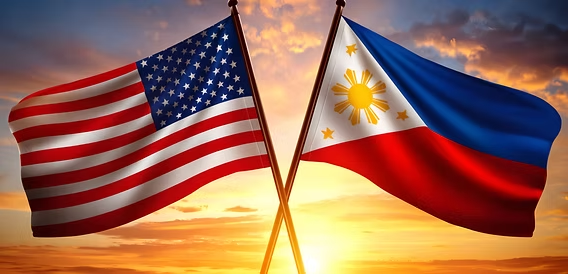
My friends and countrymen, no nation on earth has shaped the political, educational, military, financial, and charitable fortunes of the Philippines as thoroughly as the United States, and it is time this fact was stated plainly, with the evidence laid beside it, so that no honest reader need take it on faith. Indeed, a reader is entitled to weigh the source of any argument as well as its evidence, and a pro-American commentator arguing for America's record in the Philippines is exactly the voice one would expect to make this case, regardless of the underlying facts. The only honest answer to that suspicion is to check the dates and figures that follow against their sources rather than the name attached to them. That evidence must include the conflict that began this relationship, for a commentator who hides the wound cannot be trusted with the cure.
Honest accounting begins before independence, before the schools, before the typhoons, with the war that the United States itself fought against the Filipino people it would later claim to have uplifted. Fighting broke out on February 4, 1899, between American forces and Filipino revolutionaries under Emilio Aguinaldo, who had declared independence from Spain on June 12, 1898, and refused to accept a transfer of colonial masters rather than the freedom he believed his people had already won. The United States Office of the Historian records that the war killed more than 4,200 American service members and roughly 20,000 Filipino combatants, while as many as 200,000 Filipino civilians died of violence, famine, and disease, including a cholera epidemic that alone claimed some 150,000 lives in the war's final stretch. Some Filipino historians, including Luzviminda Francisco, place total Filipino deaths far higher, as much as one million, and that dispute in the historical record should be stated rather than buried.
The conduct of the war does not flatter the United States. After Filipino fighters killed fifty-four American soldiers at Balangiga on Samar in September 1901, Brigadier General Jacob H. Smith ordered Major Littleton Waller to "kill everyone over the age of ten" and turn the island into "a howling wilderness." That order led to between 2,000 and 50,000 Filipino deaths on Samar alone, depending on whose count one accepts, and it became public only through Waller's own court-martial. Smith was tried for it in 1902 and convicted, though only of "conduct to the prejudice of good order and military discipline," a sentence amounting to a forced retirement rather than the punishment the crime deserved. President Theodore Roosevelt declared the war officially over on July 4, 1902, though Moro resistance in the south continued for another decade, ending only at the Battle of Bud Bagsak in 1913.
None of this can be justified. It must, instead, be weighed honestly against what followed, because accountability without exemption applies to nations as much as to candidates. The same United States that ordered Samar's devastation is the one that, within three years of that war's end, was dispatching six hundred of its own teachers to build a free school system for the children of the people it had just finished fighting, and that within forty years would bind itself by statute to surrender every particle of the sovereignty it had taken by force. A nation's worst chapter and its best one are both part of its record. The question a fair reader must ask is not whether America's hands were ever bloody in the Philippines, for they were, but whether the decades that followed represent atonement through action or merely words. The evidence that follows is offered for the reader to judge that question for themselves.
The Philippines did not borrow a flag from America. It borrowed a framework. The Tydings-McDuffie Act of March 24, 1934, authored by Senator Millard Tydings and Representative John McDuffie and signed by President Franklin Roosevelt, set a ten-year transition to full Philippine independence and required the Filipino people to draft their own constitution under its terms. That constitution was completed by a 202-member convention on February 8, 1935, certified by Roosevelt on March 25, 1935, and ratified by the Filipino people themselves on May 14, 1935. The result, as the National Historical Commission of the Philippines records, was a charter built "based on the American model," republican in form, containing a bill of rights, and widely regarded as the best-written Philippine charter ever produced. Independence followed precisely as promised, on July 4, 1946, when President Truman signed Proclamation 2695 recognizing it. No other colonial power in the history of the Pacific bound itself by statute to a date certain and then kept that date through a world war.
In August 1901, an army transport ship named Thomas arrived in Manila Harbor carrying roughly six hundred American teachers, men and women drawn from 193 colleges and universities across forty-three states, dispatched under Act No. 74 to build, from the ground up, a free public school system taught in English. They became known as the Thomasites. They built the Philippine Normal School to train Filipino instructors, the Philippine School of Arts and Trades for vocational training, and in 1908 the University of the Philippines itself. The results were not symbolic. School enrollment surged from 150,000 students in 1903 to 1.2 million by 1934, and literacy, which stood below ten percent at the end of Spanish rule, climbed to roughly sixty-five percent under the American system. This is also why the Philippines stands today as one of the largest English-speaking nations on earth, a fact that continues to open doors in commerce, diplomacy, and overseas employment for millions of Filipinos who have never set foot in Tacloban or Cebu, let alone Boston or Sacramento.
When Japan invaded the Philippines on December 8, 1941, the United States did not abandon its commonwealth. General Douglas MacArthur commanded a combined force of roughly 100,000 Filipino and 20,000 American troops in defense of Luzon. When the position became untenable, President Roosevelt ordered MacArthur to Australia, and MacArthur left behind 90,000 American and Filipino soldiers who would endure the Bataan Death March and the fall of Corregidor. Historians at the George C. Marshall International Center record this as among the worst military defeats in American history, with 23,000 American personnel and roughly 100,000 Filipino soldiers killed or captured. MacArthur did not let that loss stand. He kept his word. On October 20, 1944, he waded ashore at Leyte and declared, "People of the Philippines, I have returned." The fighting to retake the islands killed more than a thousand American soldiers in Manila alone and cost the United States more than 8,000 killed or missing on Luzon in 1945. Men from Iowa and Texas and California did not die on Philippine soil by accident. They died there because their country had made a promise and intended to keep it.
The promise did not end when the surrender documents were signed on the USS Missouri. Six years later, on August 30, 1951, the United States and the Philippines signed the Mutual Defense Treaty in Washington, binding each nation to treat an armed attack on the other in the Pacific as a threat to itself. That treaty has now outlived every other security guarantee America has built in Asia, and Washington has reaffirmed it repeatedly, including through the 2011 Manila Declaration and a 2025 Senate resolution condemning Chinese coercion in the West Philippine Sea. The Mutual Defense Treaty is the trunk from which every later branch of the alliance grows: the 1999 Visiting Forces Agreement, which gives American troops legal standing to train alongside Filipino soldiers, and the 2014 Enhanced Defense Cooperation Agreement, which allows the United States to build and stock supplies at nine Philippine military bases without ever establishing a permanent American base on Philippine soil.
This architecture is not free of friction, and an honest reckoning says so plainly. The Visiting Forces Agreement has long drawn criticism over its jurisdiction provisions, which determine whether American servicemen accused of crimes against Filipinos are tried by Philippine courts or held by their own command, a grievance sharpened by the 2014 killing of Filipino transgender woman Jennifer Laude by a U.S. Marine. President Duterte moved to terminate the agreement outright in February 2020, only to suspend that termination three times before fully reversing it in 2021. The Enhanced Defense Cooperation Agreement has drawn its own controversy, particularly the 2023 expansion to four new sites in northern Luzon facing Taiwan, which provincial governors and members of the Marcos family itself criticized as exposing the Philippines to Chinese retaliation in a conflict not its own. These are legitimate Filipino objections rooted in legitimate Filipino sovereignty, and no honest commentator should waive them away simply because the alliance they concern is otherwise sound.
Yet when the test came, the alliance held. In May 2017, militants loyal to the Islamic State seized the southern city of Marawi, raised the black flag over its mosque, and triggered the longest urban battle in modern Philippine history. Within weeks, United States Special Operations Command Pacific confirmed, at the request of the Philippine government, that American special operations forces were assisting Armed Forces of the Philippines commanders on the ground, while a Navy P-3 Orion surveillance aircraft and an armed Gray Eagle drone provided intelligence over the besieged city. In the same month, the United States delivered 200 Glock pistols, 300 M4 carbines, one hundred grenade launchers, and four mini-guns worth roughly five million dollars to the Philippine military, followed by two Cessna surveillance aircraft worth thirty-one million dollars in July and a radar system for the Philippine Navy in August. The five-month siege killed more than a thousand Filipino soldiers, militants, and civilians and reduced much of Marawi to rubble, but it did not end in an Islamic State stronghold in Southeast Asia, and American intelligence, equipment, and personnel were present at the request of Manila for that very reason. This is what a defense treaty signed in 1951 still means in practice three generations later: not a yellowed document in an archive, but American assets over a Philippine city the week Filipino soldiers needed them most.
It is fashionable in certain circles, both Filipino and American, to wave away the entire American record as colonial guilt repackaged as friendship, and to suggest that China offers a cleaner, more equal partnership unburdened by the sins of empire. The evidence does not support that suggestion, and a fair accounting requires naming what China has actually done in Philippine waters rather than what it claims to offer, which is what I did in Why Filipinos Should Give a Damn about Panatag Shoal. In 2012, China seized effective control of Scarborough Shoal, a reef well within the Philippines' own exclusive economic zone, following a standoff with Philippine vessels, and has occupied it ever since. In 2016, the Permanent Court of Arbitration in The Hague ruled, in a case the Philippines itself brought, that China's expansive "nine-dash line" claim over the South China Sea had no basis in international law and that China's land reclamation and harassment of Philippine vessels violated Philippine sovereign rights. China rejected the ruling outright, calling it "null and void," and has simply continued the conduct the tribunal found unlawful.
That conduct has only intensified. Philippine Coast Guard and fisheries vessels attempting to resupply Filipino soldiers and fishermen near Second Thomas Shoal and Scarborough Shoal have been repeatedly rammed, blocked, and blasted with water cannons by Chinese Coast Guard ships, with documented incidents in 2023 and 2024 alone causing damage to Philippine vessels and injuries to Filipino personnel, including one sailor who lost a finger in a June 2024 confrontation. Chinese vessels have used military-grade lasers against Philippine Coast Guard crews, temporarily blinding them, and Chinese ships have on occasion swarmed Philippine waters in numbers exceeding 190 vessels at a time. The United States, by contrast, supported the 2016 arbitration ruling, has formally confirmed since 2019 that Philippine vessels, aircraft, and forces operating anywhere in the South China Sea fall under the protection of the 1951 Mutual Defense Treaty, and pledged $500 million in foreign military financing in 2024 to help the Philippines defend its own waters. One ally helped the Philippines win a legal judgment against the very claims now being enforced with water cannons. The other is the power firing the water cannons. China extends the Philippines no defense treaty, no comparable disaster relief record, and no comparable investment in Filipino education or institutions, only a competing claim to Filipino territory backed by ships that ram Filipino sailors. The contrast is not rhetorical. It is observable in the West Philippine Sea on any given month of the year.
Manila in 1945 was, after Warsaw, the most thoroughly destroyed capital city on earth. The United States Congress responded with the Philippine Rehabilitation Act of April 30, 1946, which appropriated $400 million for war damage compensation, part of a rehabilitation package that the National WWII Museum records eventually rose as high as $620 million, later $800 million. This was not foreign charity extended at arm's length. It was restitution paid by the same government that had pledged, in President Roosevelt's own words, that Filipinos would get back everything they lost in the war "to the last nipa hut and the last carabao." The funds rebuilt public utilities, hospitals, schools, and the agricultural base of a nation that had just spent three years under occupation.
It must be acknowledged, in fairness, that this rehabilitation money carried a price. The Bell Trade Act, passed two days before independence, tied the rehabilitation funds to a "parity" amendment to the Philippine constitution granting American citizens equal rights to exploit Philippine natural resources, a condition that Filipino economists and nationalists have criticized for decades as a lopsided bargain extracted from a nation with no leverage to refuse it. This criticism deserves a fair hearing rather than a dismissal, but fairness cuts both ways: no nation rebuilding from the ashes of total war was in a position to negotiate from strength, and the rehabilitation funds were disbursed and did, in fact, rebuild the islands, regardless of the terms attached. A hard bargain is not the same as no bargain at all, and the alternative on offer from the imperial powers of that era, as Japan's occupation had just demonstrated, was no bargain whatsoever.
The financial relationship today bears no resemblance to that postwar arrangement, for it is chosen rather than imposed. The Philippine information technology and business process management industry closed 2025 with more than $40 billion in export revenue and nearly 1.9 million Filipino employees, according to the IT and Business Process Association of the Philippines, with the sector now accounting for more than 8 percent of national gross domestic product. American companies remain the largest client base for that industry by a wide margin, a position no other foreign market rivals. This is not a treaty obligation or a war debt. It is millions of American businesses choosing, contract by contract and year after year, to place call centers, finance and accounting operations, healthcare information processing, and increasingly software engineering and analytics work in Filipino hands, because Filipino workers do it well. Thousands of new such jobs are created every year by a single industry built almost entirely on American demand, the largest employer of college-educated Filipinos in the country's modern history, and one no Philippine president has had to beg, borrow, or surrender sovereignty to secure.
When Super Typhoon Yolanda struck in November 2013 and killed more than 6,000 people while displacing 4.1 million more, the United States deployed a USAID Disaster Assistance Response Team within days, mobilized roughly 9,500 military personnel, delivered hundreds of thousands of pounds of relief supplies by air, and ultimately provided approximately $143 million in humanitarian and development assistance. This was not an isolated gesture. The United States Embassy in Manila confirms that since 2010 alone, the American government has provided more than $393.6 million in disaster relief, preparedness, and early recovery assistance to the Philippines. When the earth shakes or the sea rises in the Philippines, it is consistently the United States, among all the nations of the world, that arrives first and stays longest.
Beyond government programs and battlefield alliances lies a simpler, more intimate form of benefit that touches Filipino households directly, every month, without a single act of Congress required. According to the Bangko Sentral ng Pilipinas, overseas Filipino workers sent home a record $39.62 billion in personal remittances in 2025, equal to roughly 7.3 percent of the entire Philippine gross domestic product, and the United States alone accounted for 39.7 percent of that total, by far the single largest national source, more than double the share from Singapore, the next-largest contributor. This is not ancient history measured in war reparations from eighty years ago. It is a wire transfer landing in a Filipino bank account this month, and next month, sent home by some of the more than 4.4 million Filipino Americans now living, working, and in most cases, naturalized as citizens in the United States, a community the Migration Policy Institute records as 76 percent naturalized, a far higher rate than immigrants to the United States overall.
For decades, the income Filipino workers and Filipino American citizens have sent home from the United States has cushioned the Philippine economy through financial crises and pandemics alike, funded school fees and small businesses in provinces no foreign aid program reaches, and helped the Philippines build the foreign currency reserves that credit rating agencies cite when upgrading the nation's investment status. No other country on earth hosts a Filipino community of this size, this naturalized, sending this much money home. That is not colonial residue. That is millions of individual Filipino families voting with their labor and their loyalty for where opportunity actually lives, and choosing, year after year, to send the proceeds home.
Consider what this means together rather than separately. No nation gave the Philippines its constitutional template and then surrendered sovereignty on the date it promised. No nation built a school system from bamboo huts to a 65 percent literacy rate inside three decades and gave the Filipino people the English language as a permanent global asset. No nation lost tens of thousands of its own sons defending Philippine soil, then returned at even greater cost to liberate it, then bound itself by treaty to do so again and honored that promise in the streets of Marawi seventy years later. The financial reparations, the disaster relief, and the remittance lifeline detailed above complete the record; they do not need restating here to prove the point already made.
Measure that record against the only honest alternatives. Spain ruled the Philippines for over three hundred years and left behind a literacy rate beneath ten percent. Japan occupied it for three years and left behind a million dead Filipino civilians and a capital city in ruins. China today offers no defense treaty, no disaster relief comparable to America's, and no legal support for Filipino sovereignty, only coast guard cutters contesting Philippine outposts in waters a tribunal has already ruled are not its own.
We must not pretend that America's own record in the Philippines began without sin; it did not. The war of 1899 to 1902 killed tens of thousands by the bayonet and hundreds of thousands more by famine and disease the war set loose, and the howling wilderness ordered on Samar stands as a permanent stain that no subsequent generosity erases. However, a stain is not the whole garment, and the question before any honest judge of nations is not whether a power's hands were ever bloody (for every empire's hands have been), but what that power built afterwards with the years it was given. Spain answered that question with three centuries of stagnation. Japan answered it with three years of slaughter. China is answering it right now, in real time, with the same coercion named above. America answered it with schools, with a constitution surrendered on the date it promised, with tens of thousands of its own dead retaking islands it could have written off, with hundreds of millions in reparations, with disaster relief that arrives before the floodwaters recede, and with a wire transfer that lands in a Filipino household every month of every year. Measured against every honest alternative, in every category that matters to a nation's survival and its future, no other power on earth has done for the Philippines what the United States has done, and none has done more to answer for its worst chapter with its best ones, a testament to what I wrote about American exceptionalism to commemorate its 250th anniversary.
My friends and countrymen, the next time someone tells you that America has only ever exploited you, hand them the dates, the dollar figures, and the dead---all of them---the shameful and the sacrificial alike, and let the full ledger speak.
Long live the Philippines, and long live its alliance with the USA!
Stay informed!
Join a community of engaged patriots passionate about liberty, good governance, and strengthening U.S.-Philippine relations. By subscribing to Marcial's Law, you’ll receive exclusive insights and updates on policies that shape the future of both nations. Be part of the conversation that challenges the status quo and advocates for a return to constitutional principles. Subscribe now and never miss a critical update!




[…] Indisputable Reasons America Remains Exceptional at 250 2The Full Ledger: Why America Remains the Philippines' Greatest Ally 3Would America Exist Without George […]