I seek to empower people by giving them something to ponder.
By Marcial Bonifacio
7/2/2026
My friends and American countrymen, in 2009, President Barack Obama was asked whether he believed in American exceptionalism. "I believe in American exceptionalism," he answered, "just as I suspect that the Brits believe in British exceptionalism, and the Greeks believe in Greek exceptionalism." He went on, in the same remarks, to affirm America's "extraordinary role in leading the world toward peace and prosperity." The qualifying comparison, however, contained a philosophical claim worth examining on its own terms: that exceptionalism is merely a sentiment every nation holds about itself, with no nation's claim more documented or more verifiable than another's. That claim does not survive scrutiny. British exceptionalism rests on Magna Carta and parliamentary tradition; Greek exceptionalism rests on the legacy of Athenian philosophy and democracy. Neither nation can claim, as the evidence herein will show, an unbroken constitutional order of 238 years, a founding creed that naturalizes any man on Earth as a citizen, or two centuries of unrelenting resistance to terrorism stretching from the Barbary Coast to the present day. Whether the sentiment is sincere or merely diplomatic is not the question. The question is whether the claim is true, and on July 4, 2026, the 250th anniversary of America's Declaration of Independence, the historical record answers it.
Liberty in America takes several distinct forms, each with its own evidentiary record: political liberty, in which sovereignty flows from the people rather than a crown; religious liberty, secured against the kind of persecution that consumed Europe for centuries; liberty regardless of race, which survived the nation's founding compromise with slavery and ultimately triumphed over it; economic liberty, which built the most productive nation in history; and the liberty that America's military has, at great cost and with relative restraint, extended to others abroad.
First and foremost, America’s government is the world's first to be based on natural law and the principle that sovereignty emanates from the people, not from the monarchy or the government. That is in direct contrast to the theocratic concept of the "Divine Right of Kings,” which has pervaded the world for millennia until the American Revolution. “Instead of rights and privileges flowing ‘down’ from the king,” states political historian Dinesh D’Souza, “they now flow ‘up’ from the people to the government.” He further elaborates:
In the old case, the king granted limited authority and power to their rulers. Elsewhere, the people are subjects and thus subjected to the laws, possessing rights only at the behest of the government. In America, there are no subjects, only citizens. Citizens are subject only to laws that they themselves make through their elected representatives. The representatives possess this power at the behest of the people, and they must obey the same laws as the rest of the people.
Pulitzer Prize-winning historian Gordon Wood reinforces this point, arguing in The Radicalism of the American Revolution (Vintage, 1993) that the founding represented nothing less than the destruction of the ancient assumption that some men were born to rule and others to obey. "The Revolution," Wood writes, "was the most radical and most far-reaching event in American history." What made it radical was not battlefield victory but the wholesale dismantling of a social order in which birth, blood, and title determined one's place. For the first time in modern history, a government was constructed on the premise that no man was inherently superior to another — a premise so self-evident to Americans today that its revolutionary audacity is almost entirely forgotten.
This was no accident of rhetoric. Historian Bernard Bailyn, in his Pulitzer Prize-winning Ideological Origins of the American Revolution, demonstrates that the founders' invocation of natural rights reflected a deeply constructed political philosophy — assembled from decades of reading Locke, Cicero, the English Whigs, and Montesquieu. The founders did not merely declare that rights were natural; they engineered an entire governmental architecture to protect those rights from the force history had proven most likely to destroy them: concentrated governmental power. The American founding was an act of deliberate intellectual design — not circumstance or accident.
That being said, the government of the world’s first modern constitutional republic (the U.S.A.) was not established to protect its own interests or even the interests of any one of its own branches independent of the people. Nor was it framed to protect and perpetuate the privileged classes of dynasties, the wealthy, ecclesiastical, technocratic, or the intelligentsia. Indeed, most of the founders who signed America’s Declaration of Independence essentially forfeited their money, property, and family in the cause for liberty---one from which they derived no economic profit. Hence, President Abraham Lincoln aptly referred to the infant government as a “government of the people, by the people, for the people,” a radical concept unheard of then and often taken for granted today. It is also the reason the founders rejected “titles of nobility” in Article II, Section 9 of the Constitution, and was illustrated by the French statesman Alexis de Tocqueville when he visited America in 1831 and observed that even a waiter is often called “sir,” though he is not a knight.
Just as Americans sought refuge from political persecution in their pursuit of self-governance, so, too, did they seek freedom of religion and freedom from religious coercion by the state. America’s founders scrutinized the history of religious persecution and abuse of political power among the great French and English empires, wherein only the religion of the despots was legally recognized, while religious minorities were oppressed, terrorized, or even executed.
For example, from 1533-1534, King Henry VIII of England severed ties with Pope Clement VII and the predominant state-sponsored Catholic Church in order to establish the Church of England of which he declared himself its “Supreme Head.” As such, he outlawed papal authority, making any dissent of his title treasonous and punishable by death. He seized vast lands and wealth of the Catholic estate, while destroying shrines to saints, and executing about 200 Catholic dissenters.
During France’s Reign of Terror (1793-1794) of National Convention leader Maximilian Robespierre, the deistic “Cult of the Supreme Being” was established, which was neither Catholic nor Protestant. Since the Catholic Church represented the old regime, its members were the persecuted majority in that the clergy were imprisoned and executed, while the cathedrals were stripped of their religious symbols and repurposed for the state. Protestants shared the same fate, since they were perceived as competing with state loyalty. Finally, since Robespierre considered atheists to be immoral, they also became vulnerable to persecution and execution.
Cognizant that many Christians were fearful of such instances of a potentially oppressive national church or state-mandated religion under the new American government, President Thomas Jefferson assured them of the establishment of a “wall of the separation of church and state,” whereby the state could not hinder religious institutions or individuals with regard to religious beliefs, rituals, or practices. Hence, the First Amendment of the Constitution asserts that “Congress shall make no law respecting an establishment of religion, or prohibiting the free exercise thereof . . . .”
After all, the primary reason the Pilgrims and Puritans settled in America in the early 17th century was to evade religious persecution in England. Such religious liberty was one of a few factors that inspired the Great Migration in which approximately 20,000 Englishmen settled in America within a decade. Religious liberty was so highly regarded by Jefferson that his authorship of the Virginia Statute for Religious Freedom was one of three of his achievements engraved on his tombstone.
Even liberty for blacks was no exception, for their time came to pass in the event of the Civil War (in which 324,000 white soldiers died defending the freedom of blacks) and ratification of the 13th Amendment to the Constitution (which abolished slavery). Subsequent amendments and laws were passed to deinstitutionalize racism and racial discrimination, which included equal rights to citizenship, suffrage, public transportation, educational and employment opportunities in both the public and private sectors, and the abolition of apartheid.
For example, the Insurrection Act of 1807 and Enforcement Act of 1871 were invoked to allow the President to use military force against the Ku Klux Klan (the anti-black terrorist organization) to protect the civil rights of blacks. This led to mass arrests and prosecutions of Klan members. During racial integration of public schools and universities in the 1950s and 1960s, Presidents Dwight Eisenhower and John Kennedy sent the national guard to several schools to protect the new black students.
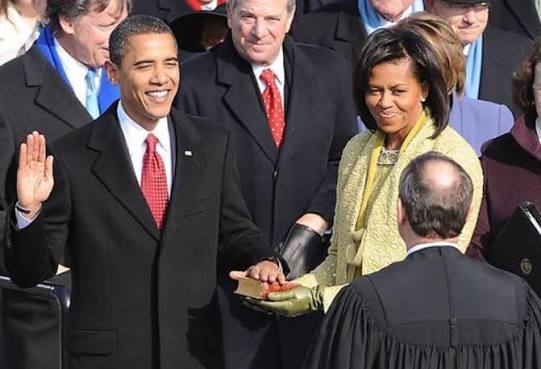
Such anti-racist measures have been proven to be very effective in that blacks have not only been able to occupy positions traditionally held by whites, they have climbed the corporate ladder as CEOs, board directors, and major shareholders. Many have become entrepreneurs, starting and growing small businesses. They have excelled in media and entertainment. They have occupied every branch of government---local and federal. America’s first black president, Barack Obama, was elected in 2008 and re-elected in 2012 (a feat that would have been mathematically impossible without the white vote, thereby debunking the myth of America as a predominantly racist nation). Even the second highest public office was presided over by America’s first black female vice president, Kamala Harris.
In a word, social progress in that the redress of racial grievances has been fairly swift and impactful since America’s founding. Even the black liberal sociologist Orlando Patterson, who was born under British colonial rule in Jamaica, emphasizes this point:
America, while still flawed in its race relations, is now the least racist white majority society in the world; has a better record of legal protection of minorities than any other society, white or black; offers more opportunities to a greater number of black persons than any other society, including all of Africa; and has gone through a dramatic change in its attitudes toward miscegenation.
The naysayers may contend that all such redress of racial grievances and injustices are the result of reformers or public servants who lived long after America’s founders. This may imply that not only are the founders unworthy of praise, but they may have even framed the Constitution embedding slavery and racial inequalities in the DNA of America. Of course, that would be a plausible contention that America was, indeed, founded on the sin of slavery, or that its founders were pro-slavery. However, history proves otherwise.
First and foremost, it is important to understand that declaring a universal truth is different from declaring it to be in full unimpeded operation at a particular time and place. Circumstances at a given time may not permit a certain group or class of persons to freely exercise their natural rights and liberties. President Abraham Lincoln made this clear in his rebuttal to pro-slavery Senator Stephen Douglass:
I think the authors of that notable instrument intended to include all men, but they did not intend to declare all men equal in all respects . . . . They defined with tolerable distinctness, in what respects they did consider all men created equal—equal in "certain inalienable rights, among which are life, liberty, and the pursuit of happiness." They did not mean to assert the obvious untruth, that all were then actually enjoying that equality, nor yet, that they were about to confer it immediately upon them. In fact, they had no power to confer such a boon. They meant simply to declare the right, so that the enforcement of it might follow as fast as circumstances should permit.
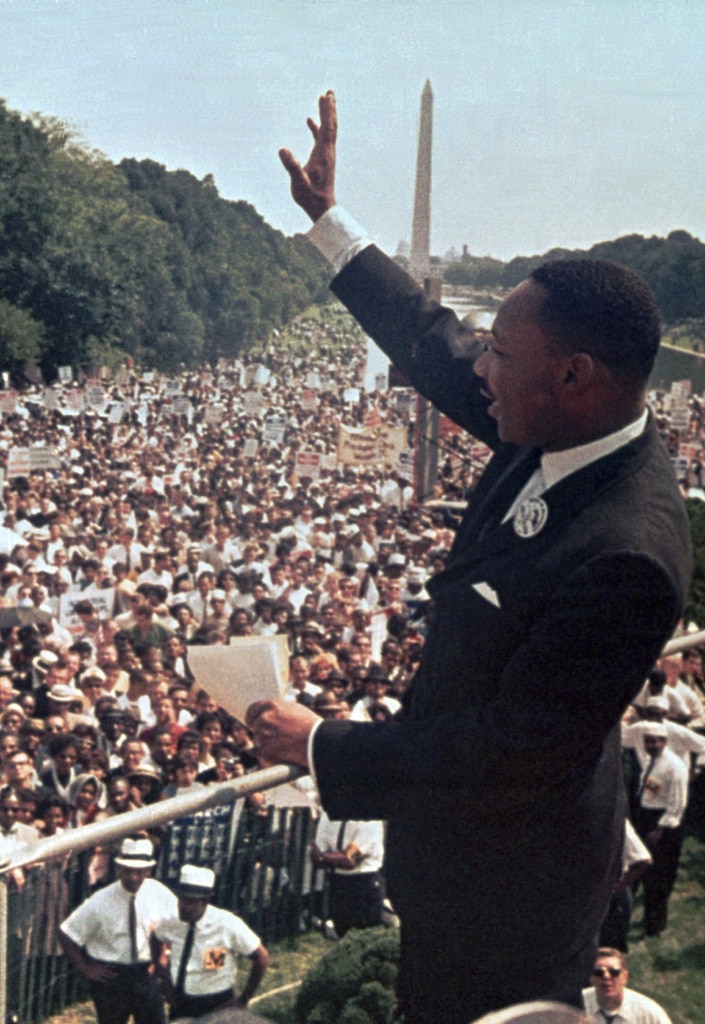
Even the black civil rights leader Dr. Martin Luther King, Jr. stated that “when the architects of our republic wrote the magnificent words of the Constitution and the Declaration of Independence, they were signing a promissory note to which every American was to fall heir,” and it was a “promise that all men, yes, black men as well as white men, would be guaranteed the ‘unalienable rights’ of ‘life, liberty, and the pursuit of happiness.’” Now that it is established that the founders understood the universality of natural rights, what follows are some of the measures they took to uphold such a self-evident truth.
When Thomas Jefferson wrote the first draft of the Declaration of Independence, he condemned King George III for several grievances, one of which was slavery, stating:
He has waged cruel War against human Nature itself, violating its of Life and Liberty in the Persons of a distant People who never offended him, captivating and carrying them into Slavery in another Hemisphere, or to incur miserable Death, in their Transportation thither. This piratical Warfare, the opprobrium of infidel Powers, is the Warfare of the Christian King of Great Britain.
He has prostituted his Negative for Suppressing every legislative Attempt to prohibit or to restrain an execrable Commerce, determined to keep open a Market where Men should be bought and sold, and that this assemblage of Horrors might want no Fact of distinguished Die.
Unfortunately, the dissenting committee members, who oversaw the draft, omitted it permanently from the adopted draft. Regardless, the Declaration’s preamble asserts “that all men are created equal.” It does not qualify a specific group or kind of men. It clearly states “all men,” which would logically include blacks, would it not?
In Article I, Section 2 of the Constitution, the Three-Fifths Clause states:
Representatives and direct Taxes shall be apportioned among the several States which may be included within this Union, according to their respective Numbers, which shall be determined by adding to the whole Number of free Persons, including those bound to Service for a term of years, and excluding Indians not taxed, three-fifths of all other Persons
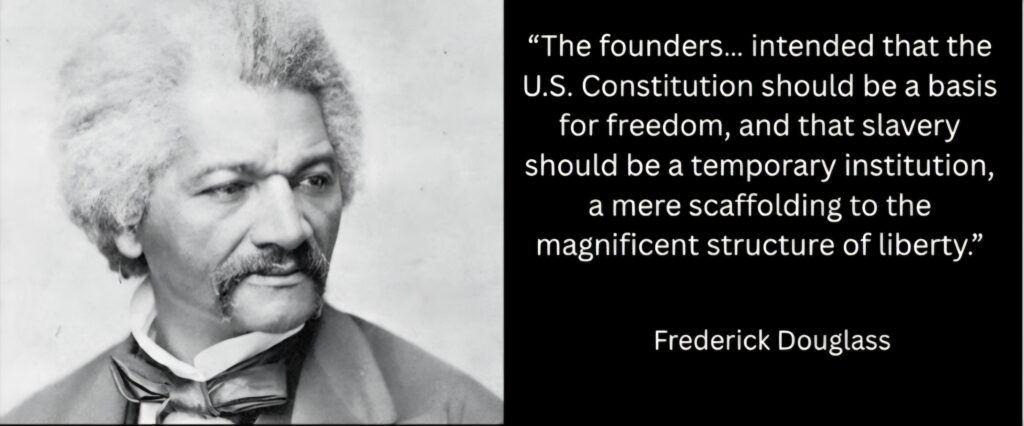
This indicates that every five slaves will be counted as three people (three-fifths or 60% of the slave population) for purposes of representation in the House of Representatives. The alternative would be to legally count one slave as a single person, and as such, would empower the slaveholding states further due to increased representation. Hence, diminishing the slave population by two-fifths restricts the power of the slaveholding states. As the abolitionist and former slave Frederick Douglass states:
I answer — It is a downright disability laid upon the slaveholding States; one which deprives those States of two-fifths of their natural basis of representation. A black man in a free State is worth just two-fifths more than a black man in a slave State, as a basis of political power under the Constitution. Therefore, instead of encouraging slavery, the Constitution encourages freedom by giving an increase of “two-fifths” of political power to free over slave States. So much for the three-fifths clause; taking it at is worst, it still leans to freedom, not slavery; for, be it remembered that the Constitution nowhere forbids a coloured man to vote.
Other anti-slavery measures included the 1787 Northwest Ordinance which outlawed slavery in the territory that would become Ohio, Indiana, Illinois, Michigan, and Wisconsin. In 1807, President Thomas Jefferson signed into law a bill that outlawed the importation of slaves. Of the thirteen original states, five either abolished slavery outright or were trending towards abolition by the time the Constitution was signed in 1787. Among them were Massachusetts, New Hampshire, Pennsylvania, Rhode Island, and Connecticut. Although Vermont was not one of the original states, it was the first territory to outlaw slavery in 1777. Additionally, Benjamin Franklin co-founded a Philadelphia abolitionist organization, and George Washington willed all of his slaves free upon his death.
Furthermore, it is clear that not all of America’s founders supported slavery or its perpetuation. All things considered, it seems grossly unfair to condemn all the founders as pro slavery or to assert that America’s government was founded on slavery in light of the anti-slavery policies legislated by various states and the federal government.
Perhaps skeptics or naysayers may then question why the anti-slavery founders did not simply reject slavery outright at the 1787 Constitutional Convention. My answer is politics, which sometimes necessitates short-term compromises in order to secure long-term gains. Political historian Dinesh D’Souza elaborates:
So the choice facing the founders in Philadelphia was not whether to have slavery or not. Rather, it was whether to have a union that temporarily tolerated slavery, or to have no union at all. The continent of North America might then have become an amalgam of smaller nations---vulnerable to the depredations of foreign empires---and slavery might have continued longer than it actually did.
Just the fact that the anti-slavery founders had the foresight to engineer such a government that would severely restrict and facilitate the eventual demise of a perennial, universal institution, illustrates their remarkable prescience. Hence, America’s history of slavery and racial injustices, in no way, undermines the nation’s exceptionalism. On the contrary, the self-corrective mechanisms embedded in its founding documents only confirm it. No other 18th century government can make that claim, not even contemporaneous empires like Britain, France, or Spain.
In America, liberty also extends to the economic sphere in that, as economist Milton Friedman stated, “it prevents one person from interfering with another in respect of most of his activities.” He further elaborates:
The consumer is protected from coercion by the seller because of the presence of other sellers with whom he can deal. The seller is protected from coercion by the consumer because of other consumers to whom he can sell. The employee is protected from coercion by the employer because of other employers for whom he can work, and so on.
In other words, a centralized authority does not exist to govern such an autonomous arrangement of various competitors. Instead, the entire system is regulated by what economist Adam Smith, in his pioneering work, The Wealth of Nations, dubbed “the invisible hand of the market,” otherwise known as the free market system or capitalism. What makes it unique to America is that the nation was the first to frame a legal system built on market principles enshrined in the Constitution, which is why we are also celebrating, alongside America’s 250 years of independence, the publishing of Smith’s book in 1776.
Additionally, while free market capitalism developed only partially or with feudalistic restrictions in Europe (whereby upward social mobility was stagnant due to class rigidity imposed by an established aristocracy), full-fledged capitalism developed in America with respect to the individual rights of “the common, ordinary man” without an aristocracy of nobility coupled with the elements of low taxation, minimal regulations, secure property rights, and strong patent and copyright protections, essentially allowing upward social mobility to anyone of any class and encouraging new inventions and technology.
The results were not merely theoretical. Economic historian Angus Maddison, whose reconstruction of global GDP data remains the authoritative benchmark for pre-modern economic history, calculated that between 1800 and 1900, average global income nearly doubled (rising from approximately $1,140 to $2,180 per person annually). Yet America did not merely keep pace with that global trend; it surpassed it so decisively that by the close of the 19th century, the United States had overtaken Great Britain (the world's previous economic leader) in both GDP per capita and labor productivity, which was a gap that would only widen further into the 20th century. No nation in history had risen so far, so fast, within a single constitutional framework built explicitly to protect economic liberty.
Nor was this prosperity accidental. The founders encoded innovation into the Constitution itself. Article I, Section 8 empowered Congress to secure "for limited Times to Authors and Inventors the exclusive Right to their respective Writings and Discoveries,” the only clause in the Constitution where the framers took the unusual step of specifying not merely a power, but its explicit purpose. The Patent Act was signed into law in April 1790, just one year after ratification. In that first year, 3 patents were granted. By 1830, that annual figure had grown to 544. By 1900, the United States had issued a cumulative 640,000 patents (a figure that prompted a former Prime Minister of Great Britain, perhaps the most industrially advanced nation of the era, to observe that "in no one country, I suppose, is there so careful a cultivation of the inventive faculty.") From the cotton gin to the telegraph to the lightbulb, the constitutional protection of intellectual property was the invisible scaffolding beneath America's century of invention.
Even in the modern era, America has the comparative advantage due to the entrepreneurial traits of risk-taking, ambition, and self-promotion being entrenched in the national culture, whereas economic equality and economic security are valued more than economic liberty in Western Europe (hence, higher taxes, more regulations, bigger safety net). Likewise, the world’s brightest minds are nurtured in the most prestigious institutions of innovation like MIT, Caltech, and Silicon Valley. Finally, starting a business in the country that provided the world with the assembly line, the internet, and the smartphone inspires consumer trust, enhances credibility, and facilitates access to international markets.
With regard to upward social mobility, in Rage and the Republic (Simon & Schuster, 2026), political commentator Jonathan Turley cites a recent study of wealthy individuals in the Forbes 400 with these findings:
. . . in 2011, only 32 percent came from wealthy families---down from 60 percent in 1982. Twenty percent came from poor families, and the majority did not inherit a family business. Roughly 70 percent started their own businesses (up from 40 percent in 1982). In 2019, another study found that 79 percent of millionaires were self-made.
As a result, America has quickly become a prosperous nation, so much so that it can and does expand its wealth abroad in the form of jobs, goods and services, and foreign aid. “More people have been lifted out of poverty by capitalism,” states Ambassador Mike Huckabee, “than any other economic system ever to appear in the history of the world. This is a proven fact and it is a primary reason why the United States is a superpower that has blessed the rest of the world with its innovations and generosity when need has arisen.”
In addition to defending liberty within its own borders, America has utilized the world’s most powerful military for the defense of other free nations and the spread of liberty in others enveloped in a tyrannical government. In 1950, the U.S. sent troops to Korea to prevent the communists from dominating the entire peninsula. The result was an independent South Korea in which hundreds of American troops are stationed to guard against a potential North Korean invasion until today. Related to the Korean conflict, the U.S. has provided military defense for Taiwan against the People’s Republic of China. (Perhaps you should express gratitude for your smartphone or laptop and their AI chips.) In 1990, after Iraq invaded Kuwait, the U.S. led a 42-country coalition to liberate it and restore its independence. During the Serbian “ethnic cleansing” massacre of thousands of Muslim ethnic Albanians in Kosovo in 1999, the U.S. led NATO on a bombing campaign to quash Serbian forces, eventually leading to Kosovo’s independence from Serbia.
What all such military missions share in common is America’s benevolence in preserving and spreading liberty globally without colonial annexation or even usurping natural resources from the aforementioned countries, unlike other historical great powers. As I pointed out in The Full Ledger: Why America Remains the Philippines’ Greatest Ally, it could be argued (as an exception) that the U.S. annexed the Philippines without its consent in 1898. However, the former educated Filipinos, taught them English, fought alongside them against the Japanese imperialists, and assisted them in establishing their own constitution for self-governance, which eventually led to their independence from the U.S. on July 4, 1946. By stark contrast, the Philippines’ former colonial power, Spain, ruled the islands for over 300 years and left no such democratic infrastructure to speak of.
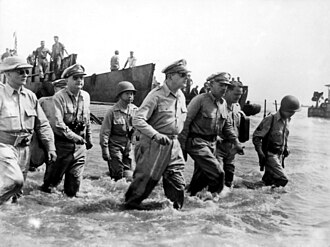
In spite of the aforementioned U.S. military missions, as well as numerous others not mentioned, it is notable that military expenditures have remained below 4% annually. According to the Stockholm International Peace Research Institute (the globally recognized benchmark for defense expenditure data), U.S. military spending in recent peacetime years has hovered between 3 and 4 percent of GDP: in 1999 it reached a post-Cold War low of 3.09 percent; in 2019, despite spending $732 billion (nearly as much as the next ten nations combined), it amounted to just 3.4 percent of GDP; and in 2025 it stood at approximately 3 percent.
By contrast, Russia devotes 7.1 percent of its GDP to its military, and Ukraine, in wartime, has committed 39.6 percent. The reason America can project unmatched global power at a comparatively modest fiscal burden is the same reason it surpassed Great Britain as the world's leading economy by 1900: the free market system (economic liberty enshrined in its Constitution) generates a productive base so vast that military supremacy becomes, in relative terms, economically sustainable. That accounts for the nation’s relative safety and security from foreign invaders by a mighty and exceptionally advanced military apparatus. (U.S. is the only nation with stealth bombers, deep bunker buster bombs, and Space Force which played a critical role in intercepting Iran’s ballistic missiles during Operation Epic Fury.)
In summary, political commentator Dennis Prager elucidates the role of America with regard to liberty:
It was the country that most inspired other countries to be free. It is the country that has been free the longest. . . More people from more countries have immigrated to America in order to be free than to the rest of the world’s countries put together. More black Africans have immigrated to the United States voluntarily---looking for freedom and opportunity---than came to the United States involuntary as slaves. . . The fact is that America has been the greatest model of liberty, the greatest spreader of liberty, and the greatest preserver of liberty the world has ever known.
Perhaps the most credible verdicts are those rendered not by partisans, but by witnesses: Orlando Patterson, the black Jamaican-born Harvard scholar of slavery, who declares in The Ordeal of Integration (Basic Books, 1998) that America is "the least racist white-majority society in the world"; black civil rights leader Dr. Martin Luther King, Jr., who acknowledged that the Declaration's universal natural rights constituted "a promissory note to which every American was to fall heir"; and Frederick Douglass, the black abolitionist and former slave, who revered the U.S. Constitution and dubbed it "a glorious liberty document." Indeed, their testimony is that of witnesses, not partisans, and any competent attorney will affirm that witnesses provide the most persuasive evidence of all. I rest my case.
The average national constitution lasts 17 years, a figure calculated by political scientists Zachary Elkins, Tom Ginsburg, and James Melton in their landmark study The Endurance of National Constitutions (Cambridge University Press, 2009). That single arithmetic fact may be the most concise summary of American exceptionalism ever produced.
Constitutional law professor Hugh Hewitt captures why:
The work of collective genius that is the Constitution has been tested by everything from an actual civil war that claimed 600,000 lives to various panics, two world wars, the Great Depression, and the Great Recession, not to mention impeachments and assassinations, political-judicial meltdowns like Florida in 2000, and dozens of scandals---and it does not break. It is more resilient than any other modern constitution, a remarkable, nearly perfect balance of competing powers and separated authorities that has endured and will endure. Those who fear it is off the road and in the ditch have to ignore history’s many examples of America righting itself after trauma and setback.
Yale constitutional scholar Akhil Reed Amar, whose book entitled America's Constitution: A Biography (Yale University Press, 2005), remains the definitive academic treatment of the document, reinforces Hewitt’s assessment, noting that the Constitution's genius lies not in its rigidity but in its capacity to absorb conflict through amendment, interpretation, and institutional adaptation rather than replacement.
The historical record of other nations throws this achievement into sharp relief. The Philippines, which has operated under 7 constitutions since 1899, offers a particularly instructive contrast: each charter change has followed a period of political rupture, from the Marcos dictatorship to the EDSA revolution to the ongoing debates over federalism. By contrast, the American Constitution has absorbed comparable pressures: a civil war, two world wars, a Great Depression, and presidential assassinations, which never resulted in the national charter’s replacement. Each constitutional replacement represents not merely a legal revision but a fundamental collapse of political order.
That America has experienced only one such reset in 238 years, while France has experienced 15, Germany 4, China 8, Greece 10, Venezuela 25, and Haiti 21, is not coincidence. It is the compounding dividend of founders who, as historian Bernard Bailyn demonstrated, designed their governmental architecture with a deliberate, historically informed understanding of how republics fail and built the mechanisms to prevent it.
Hence, constitutional stability is not merely a legal achievement. It is the precondition for every other liberty described above, e.g., the freedom of religion, the free market, the protection of civil rights, and the projection of military power in defense of others. Without the document, none of the rest follows.
Indeed, no American can become a Filipino, a Nigerian, a Mexican, or a Russian in the same way virtually any one of those nationals or ethnic groups can become an American. Throughout history, virtually all societies (whether tribes or countries) had a national or group identity correlated with its ethnic or racial identity. Such groups were further divided by blood and marital bonds. Hence, employers (often distrustful of non-blood relations) generally offered jobs and other opportunities to family members (being of the same race or ethnicity), unlike in America.
In fact, America was one of the first nations, if not exclusively the first nation, to deviate from this historical norm by de-emphasizing nationality, ethnicity, family, and bloodline in favor of individual worth or individual achievement---one of the country’s most cherished values. That is why, as political commentator Dennis Prager states, “A third-generation Turk in Germany, born in Germany, fluent and accentless in German, is rarely considered a German by other Germans. In America, however, a first-generation Turk who is not fluent in English and speaks with a distinct accent is considered an American by other Americans.”
This is due to America’s motto, E Pluribus Unum, which is a rare governing principle with no true parallel, translated literally from Latin as “from many, one.” That is to say, from the assimilation of diverse ethnicities, nationalities, and cultures, is a unified nation, namely, the United States of America. Members of such groups need simply adopt the American creed.
Political scientist Samuel Huntington defined the American creed as the embodiment of “liberty, equality, individualism, representative government, and private property” and argued that “millions of immigrants and their children achieved wealth, power, and status in American society precisely because they assimilated themselves into the prevailing American culture.” Two examples include the founder of Carnegie Steel Company, Andrew Carnegie, who was born in Scotland and co-founder of WhatsApp, Jan Koum, who was born in Soviet Ukraine. Perhaps the most striking example of immigrant assimilation is illustrated by Prager in explaining why “God Bless America---probably the American people’s favorite national song and its unofficial anthem---could be written by a Russian Jewish immigrant named Israel Isidore Baline, aka Irving Berlin,“ and “he felt as American as someone whose ancestors came to America on the Mayflower.” Hence, my point remains that anyone can become American, and that no other nation can make the same claim.
Indeed, the founders scrutinized the world’s governing systems---ancient and contemporary, along with great thinkers as Socrates, Cicero, John Locke, Charles Montesquieu, and William Blackstone. The civilizations included Greece, Rome, France, and England from which the founders derived the concepts of liberty, justice, trial by jury, separation of powers, federalism, democracy, republicanism, and self-government. The founders were informed by their own tyrannical experience with King George III as well.
For example, the French political philosopher, Montesquieu (1689 – 1755), studied Rome and France in which power was concentrated in the former’s dictator (Julius Caesar) and the latter’s monarch (King Louis XIV). He concluded, “When legislative power is united with executive power in a single person or in a simple body of magistracy, there is no liberty, because one can fear that the same monarch or senate that makes tyrannical laws will execute them tyrannically.” In Federalist 47, James Madison echoed Montesquieu when he stated that “the accumulation of all powers, legislative, executive, and judiciary, in the same hands, whether of one, a few, or many, and whether hereditary, self-appointed, or elective, may justly be pronounced the very definition of tyranny.”
Of course, the obvious remedy for such a concentration of power was mixed government. Aristotle first derived the idea from his study of ancient constitutions, arguing in his Politics that a stable republic must blend monarchic, aristocratic, and democratic elements to prevent any single faction from seizing total control. Polybius then applied the theory to Rome in his Histories, identifying the Roman Republic's consuls, Senate, and popular assemblies as precisely that balance and crediting it for Rome's rise to greatness. Cicero absorbed Polybius and elaborated the argument in De Re Publica, where he defended the mixed constitution as the form of government most consistent with natural law and human reason. In turn, that work reached America's founders directly: John Adams cited Cicero extensively in his Defence of the Constitutions of Government of the United States, and Madison's notes from the Constitutional Convention reflect the same classical inheritance.
The founders also rejected democracies, since they empower the majority without protecting the minority. Madison perceived such an arrangement of power as “mob rule” or even as “tyranny of the majority,” which is just as pernicious, if not more so, than the rule of aristocracy or an elite, since it simply entails provoking an emotionally charged crowd (whether of the legislative body or a massive jury) into rash action. Consider Socrates’s condemnation to death in 399 BCE by jurors who also happened to be legislators. A massive jury of 500 members serving a dual role, bereft of any check on its whims or bias, was inherently vulnerable to emotional manipulation.
Another example entails eight generals in 406 BC. During their naval victory of the Battle of Arginusae, a storm prevented them from rescuing shipwrecked sailors. Consequently, the infuriated Athenian assembly voted to try and immediately execute all eight generals for their alleged negligence. Clearly, the single, unchecked body acted impulsively, rather than rationally. There were other cases elsewhere which is why in Greeks and Romans Bearing Gifts: How the Ancients Inspired the Founding Fathers (Rowman & Rittlefield, 2009), the classical historian Carl Richard stated, “the founders learned to see Athens as the epitome of the democratic state, a chronically unstable, often hellish, society controlled by violent and erratic mobs that frequently executed their nation’s best citizens on the flimsiest of grounds.”
That is why the founders divided Congress into a bicameral chamber. The founders criticized Greece’s unicameral legislature due to its unstable, democratic character. They pointed out that a unicameral legislature expressed the unruly passions and whims of the people at a given time, and was hence, short-lived and fickle. For that reason, the Senate was a check on the House. As I cited George Washington from my federalism commentary, “we pour legislation into the senatorial saucer to cool it” from the “hot” chamber of the House of Representatives.
Aside from the founders' structural ingenuity in the checks and balances and separation of powers at the federal level (horizontal power), they also confronted a problem that had destroyed every prior confederation in history: how to balance the power of a central government against the sovereignty of its member states (vertical power) without the whole collapsing into either tyranny or anarchy, namely, the engineering of federalism.
The founders perceived the Amphictyonic League in ancient Greece to be a failed model, since its central council lacked the power to implement its laws on the individual city-states, leading to internal conflict and the Peloponnesian War. Other rejected examples include the Swiss Confederation and the Dutch Republic due to the former’s weak executive and lack of shared national identity (making it vulnerable to foreign manipulation) and the latter’s mandatory unanimity in public policy, rather than majority rule with protections for the minority.
However, the founders favorably viewed the Lycian Confederacy model. It consisted of a federation of 23 city-states in what is now southwestern Turkey, operated from roughly the 1st century BC into the Roman period. Its system of proportional representation allocating votes in the federal assembly according to the size of each city was most impressive to Montesquieu, who cited it in The Spirit of the Laws as the model federal republic. Madison cited Montesquieu's endorsement in Federalist 9. The institutional DNA of the Lycian Confederacy, transmitted through Montesquieu to Madison, is traceable in Article I of the U.S. Constitution, which empowered the U.S. as a great empire (e.g., national defense, currency, interstate commerce), while preserving the autonomy and sovereignty of the individual states (e.g., local policing, education, property law).
Furthermore, as classical historian Carl Richard argues in The Founders and the Classics (Harvard University Press, 1994), the founders' deep study of Greek and Roman history was not merely ornamental. It was operational — a systematic effort to identify the precise mechanisms by which free republics had failed, and to engineer constitutional barriers against each of them. Athens fell to the mob; Rome fell to the dictator; Britain fell to the monarch. The Constitution was designed, with historical precision, to prevent all three, which is one of the features of American exceptionalism.
Historically, transitions of power in empires---both ancient and modern---have been violent, sanguinary, or tyrannical. For example, in 44 BCE, the Roman dictator, Julius Caesar, was assassinated by a group of rival senators that stabbed him 23 times. Civil war ensued after which two of Caesar’s assassination conspirators committed suicide, and Caesar’s great nephew, Octavian, became the first official emperor of Rome, converting it from the Roman Republic to the Roman Empire.
In 1649, King Charles I of England was overthrown and beheaded by Lt. General Oliver Cromwell, who replaced the monarchy with a republic and presided as its next head of state---“Lord Protector,” until his death from urinary tract infection or kidney disease in 1658. Ironically, after the monarchy was restored in 1660 with King Charles II (only 2 years after Cromwell’s death), he ordered Cromwell’s corpse be exhumed, hanged, and beheaded as a symbolic act of vengeance on the 12th anniversary of the execution of his father, Charles I. Cromwell’s severed head was placed on a pike to be displayed in Westminster Hall for the next 20 years.
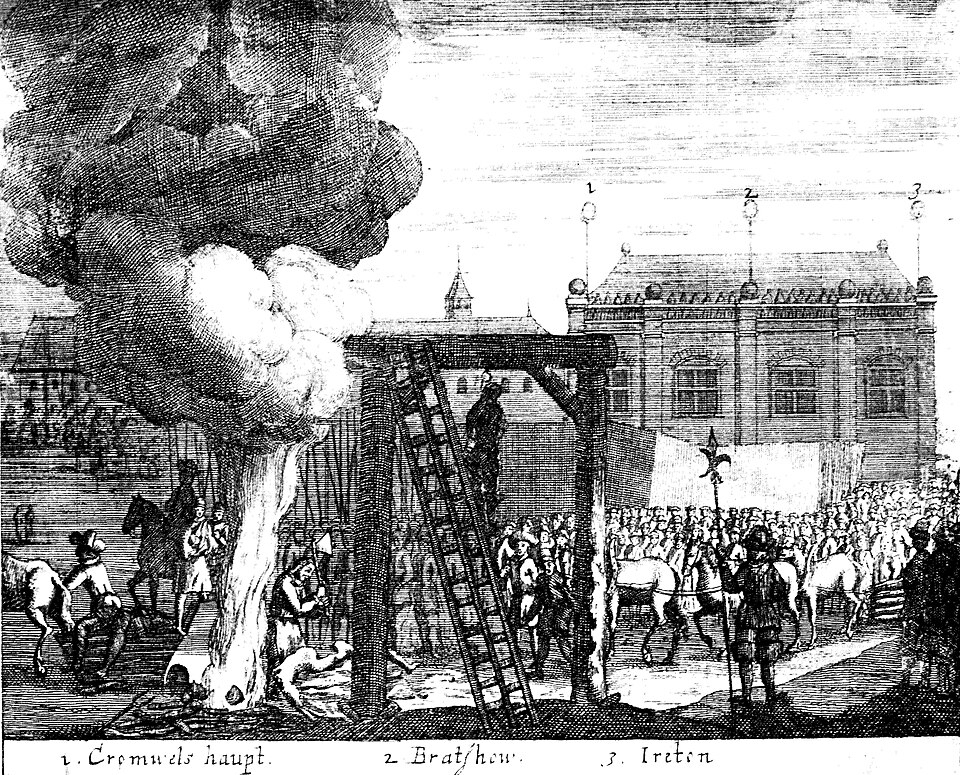
In 1793, King Louis XVI of France was violently overthrown and guillotined, and the power of the monarchy devolved to the legislative body called the National Convention, which was dominated by Maximilien Robespierre.
By contrast, America’s first two heads of state have deviated from this pattern in the transfer of power. After George Washington served his last presidential term and resumed his simple farming life, King George III styled him “the most distinguished of any man living” and the “greatest character of the age.” This was a reflection at that point in history of the incomprehensibility of a head of state voluntarily giving up power. Incidentally, this act symbolized Washington’s virtue and the political reality of the U.S.A. as a republic, not a monarchy.
Similarly, when President John Adams ran for a second term in the 1800 presidential election against his personal and political rival, Thomas Jefferson (and lost), Adams proceeded to attend his inauguration, regardless of personal animosity. This established the precedent for America’s long tradition of transferring power peacefully from one head of state to his successor for other democratic countries to emulate. More importantly, the contrast between the two rivals’ personal hostility and their institutional behavior is the exact point that distinguishes America from the preceding examples.
Alexis de Tocqueville, who toured the United States in 1831, observed that Americans of every age, condition, and disposition perpetually formed voluntary associations to accomplish what Europeans left to the state. Nearly two centuries later, the figures vindicate his observation. Americans gave an estimated $592.5 billion to charity in 2024, the largest sum the Giving USA report has ever recorded, of which roughly two-thirds came from individuals directly and nearly three-quarters once their bequests are counted.
The American nonprofit sector remains the largest in the world. More than one in four Americans, some 28 percent, formally volunteered through an organization in 2023, while a majority assisted their neighbors informally. No comparable nation sustains a private philanthropic culture of this scale.
The contrast with Europe is instructive, though it must be drawn with precision. Measured in dollars per capita, the American gives more than his European counterpart; the United Kingdom, America's nearest rival, records a higher share of citizens who report donating in a given year, yet does not approach the American total. The difference is not that Europeans are less generous by nature, but that the European model channels solidarity through taxation and the welfare state, while the American model channels it through voluntary association, precisely as Tocqueville foresaw.
The same distinction governs the foreign-aid record. The United States supplies the largest volume of humanitarian assistance in the world, accounting for roughly 40 percent of all humanitarian aid tracked in 2024, even as it commits a smaller share of its national income to official government aid than the Nordic states do. American generosity has always been private before it was governmental, and associational before it was bureaucratic. That is not a deficiency. It is the founding premise, and it is what political scientist Samuel Huntington, in his own framework, was reaching for when he tried to name what distinguishes America.
Perhaps, it is noteworthy to recall when America’s original “war on terror” occurred in the nation’s infancy in 1801. Prior to that year, American merchants sailed the high seas to the Mediterranean, wherein Islamic terrorists (also known as Barbary pirates) from Algeria, Tunisia, Tripoli, and Morocco seized their ships and cargo and ransomed the crew. As a result, the U.S. government complied and even paid annual tribute (essentially bribe money of over $1 million) to keep further piracy at bay in order to “protect” future merchants. During President Thomas Jefferson’s term, the newly-established navy (America depended on the British navy before its independence) was sent to battle the terror-sponsoring states in a war which successfully ended after 14 years under President James Madison’s term in 1815. Consequently, those North African states signed a peace treaty, effectively abolishing further ransoms and bribery payments, and marked the first time in history that a Western power refused to succumb to terrorist appeasement.
More recently, justice for the victims of Islamic terrorism has been exacted in the targeted elimination of Osama Bin Laden (founder of al-Qaeda & mastermind of the September 11 attacks in 2001), Abu Bakr al-Baghdadi (ISIS leader), Ayman al-Zawahiri (Bin Laden’s successor), and Qasem Soleimani (commander of the Quds Force of Iran’s Islamic Revolutionary Guard Corps, which is responsible for Iran’s foreign proxy terrorist network).
These eliminations were not isolated acts of retribution, but rather a sustained, bipartisan campaign spanning over two decades across multiple presidential administrations: Bin Laden under Obama in 2011, al-Baghdadi and Soleimani under Trump in 2019, and al-Zawahiri under Biden in 2022. This demonstrates that American resolve against Islamic terrorism does not expire with any single election cycle, a resolve that, as history demonstrates, traces its origins not to September 11, 2001, but to the shores of Tripoli two centuries prior.
In 2025, U.S. Central Command led partner forces in Syria to strike over 100 ISIS infrastructure and weapons site targets, captured over 300 ISIS operatives, and killed over 20. On February 28, 2026, the United States and Israel launched Operation Epic Fury, a joint military campaign against the Iranian regime, opening with nearly 900 strikes in the first twelve hours alone. The campaign's opening strike achieved what two decades of sanctions and diplomacy had not: the killing of Supreme Leader Ayatollah Ali Khamenei, the man who had ruled Iran's terror-sponsoring state since 1989. By the time the campaign concluded on May 5, 2026, it had dealt the regime's military and nuclear infrastructure a blow from which it has yet to recover.
Sustained American pressure, military and diplomatic alike, also forced Iran's hand on the Strait of Hormuz, the narrow waterway through which a substantial share of the world's oil flows. After Tehran closed the strait amid the 2026 war, President Trump issued repeated ultimatums demanding its reopening, warning that continued closure would invite further destruction of Iran's infrastructure. Over the following months, through a mix of American military pressure, economic strain on the Iranian regime, and diplomatic mediation (including from Pakistan), Iran moved by stages toward reopening the strait, though compliance remained halting and incomplete even as late as June 2026. Whatever one's final judgment of how completely the waterway has reopened, the basic dynamic is plain: it was American resolve, not Iranian goodwill, that placed Tehran under the pressure to relent in the first place. Indubitably, from the shores of Tripoli to the office of Ayatollah Khamenei, the United States has never permanently yielded to Islamic terrorism nor allowed a hostile regime to choke off the world's commerce, and no other nation on earth can make that claim.
For example, China very nearly became the civilization to project power across the world's oceans before any European fleet did, only to abandon that role and leave its consequences, including the eventual encounter with the Americas, to Europe. The disparity in advancement was not trivial. As law and public policy professor Ted Stewart observes in Seven Miracles That Saved America (Shadow Mountain, 2009), while medieval Europe was still copying scripture by hand and burning whale oil for light, China had already developed movable type, exploited natural gas, inoculated against smallpox, and built fleets capable of circumnavigating the world.
That capacity found its fullest expression in Admiral Zheng He, who commanded the most formidable naval force in the world between 1405 and 1433. Emperor Zhu Di, whose expansionist ambitions had already extended Chinese imperial reach across Southeast Asia, India, Arabia, and the East African coast, provided him both the mandate and the means to project power further still. Yet the Ming Dynasty ultimately abandoned those voyages and turned inward. The decision carried practical causes, including the enormous cost of the fleets relative to their tribute-based returns and a long-running rivalry between the eunuch faction Zheng He served and the Confucian scholar-bureaucracy that resented their influence, but it was the Confucian court officials' argument, that China was self-sufficient and that the world existed to serve it on its own terms, which ultimately prevailed and left the Americas to be reached by others. That philosophical premise, that the state is supreme and individuals exist to serve its harmony rather than the reverse, was neither new nor confined to the Ming court, yet the 1433 decision stands as one of its most consequential expressions, for it foreclosed, by deliberate choice rather than misfortune, the path that China alone among the powers of that era possessed the capacity to take.
As I stated in my commentary Could America Be a Province of China Without Christopher Columbus?, had Ming China carried that same expansionist will across the Pacific and become the civilization to shape the world's encounter with the New World, the intellectual inheritance that produced our founding documents would never have arrived on these shores, for the Declaration of Independence was not conjured from thin air but was the product of Magna Carta, John Locke's natural rights philosophy, Montesquieu's doctrine of separated powers, and one hundred and fifty years of colonial self-governance. None of these exist in the Confucian administrative tradition, where, as political scientist Samuel Huntington wrote in The Clash of Civilizations (Simon & Schuster, 1996), the emphasis on "authority, order, hierarchy, and supremacy of the collectivity over the individual, creates obstacles to democratization."
George Washington’s contribution to the existence of America is, in no way, less significant than Columbus’s. What follows is excerpted from my commentary entitled Would America Exist Without George Washington? During the American Revolution, Washington commanded a Continental Army that was chronically underfunded, perpetually undersupplied, constantly on the verge of dissolution (not to mention desertions), and outmanned by a well-equipped, professionally trained British army. Regardless, he refused to abandon it. In March 1783, at Newburgh, New York, disgruntled revolutionary officers conspired to implement a coup d'état against the newly formed government for neglecting to compensate them for their military service. However, Washington persuaded them to abandon their planned mutiny. At the 1787 Constitutional Convention in Philadelphia, the assembly came near collapse in June, when delegates from the smaller states, refusing a national legislature apportioned solely by population, threatened to walk out before the Connecticut Compromise secured their participation. Initially, the presence of the delegates was largely incumbent upon Washington’s anticipated attendance, which nearly did not occur, if not for James Madison’s persistent persuasion. Aside from Washington’s birth as an essential part of the American equation, the odds of his survival were quite slim, close to nil, since gunfire crossed his path on numerous occasions. (I elaborate in George Washington’s Close Encounters with Death.) Hence, while Columbus opened the western hemisphere to European contact, which forged centuries of English constitutional development and political thought in America, Washington is credited with the founding of America’s government and his virtuous restraint that made the republic survive (quelling of military mutiny to overthrow the government, refusal of a crown, voluntary resignation after two presidential terms).
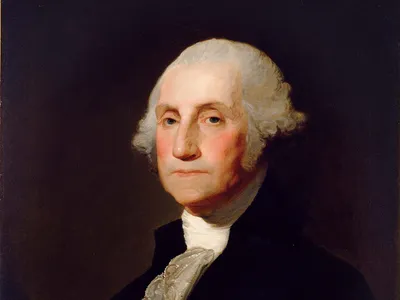
Furthermore, the case for America’s exceptionalism has been made. It would be wise that we continually reflect those points and contemplate our nation’s greatness and status, as Supreme Court Justice Joseph Story elucidates the significance of imparting its history to the youth:
If these Commentaries shall but inspire in the rising generation a more ardent love of their country, an unquenchable thirst for liberty, and a profound reverence for the constitution and the union, then they will have accomplished all that their author ought to desire. Let the American youth never forget that they possess a noble inheritance, bought by the toils, and sufferings, and blood of their ancestors; and capable, if wisely improved, and faithfully guarded, of transmitting to their latest posterity all the substantial blessings of life, the peaceful enjoyment of liberty, property, religion, and independence. The structure has been erected by architects of consummate skill and fidelity; its foundations are solid; its compartments are beautiful as well as useful; its arrangements are full of wisdom and order; and its defences are impregnable from without. It has been reared for immortality, if the work of man may justly aspire to such a title. It may, nevertheless, perish in an hour by the folly, or corruption, or negligence of its only keepers, THE PEOPLE. Republics are created by the virtue, public spirit, and intelligence of the citizens. They fall, when the wise are banished from the public councils, because they dare to be honest, and the profligate are rewarded, because they flatter the people in order to betray them.
Indeed, President Ronald Reagan aptly called America “the shining city upon a hill.” It is certainly a nation unlike any other and the last best hope for the world. Therefore, it is incumbent upon us to preserve it. As we commemorate the 250th anniversary of America’s independence on July 4, 2026, we must likewise commemorate the death anniversary of two of the nation’s founders, namely Thomas Jefferson and John Adams, on July 4, 1826 (the 50th anniversary of independence). Such a convergence of events makes July 4 an exceptional American day. In A Toast to Our Independence and Alliance, I quoted Senator Daniel Webster in his eulogy about the timing, who said, “It cannot but seem striking and extraordinary, that these two should live to see the fiftieth year from the date of that act, that they should complete that year, and that then, on the day which had fast linked forever their own fame with their country's glory, the heavens should open to receive them both at once.”
Two hundred and fifty years ago, a small confederation of states declared to the world that government derives its power from the people, not the other way around. Every reason enumerated above, from the rejection of monarchy to the resolve against terrorism, is simply that founding premise working itself out across two and a half centuries, refined by trial, tested by war, and renewed by each generation that has refused to let it die. As we celebrate this anniversary, let us also salute and pay tribute to Jefferson and Adams, and all those past heroes who have died to defend our liberty, and the current soldiers who continue to put our safety before their own.
Long live our brave soldiers!
Long live the Republic of the United States of America!
Stay informed!
Join a community of engaged patriots passionate about liberty, good governance, and strengthening U.S.-Philippine relations. By subscribing to Marcial's Law, you’ll receive exclusive insights and updates on policies that shape the future of both nations. Be part of the conversation that challenges the status quo and advocates for a return to constitutional principles. Subscribe now and never miss a critical update!








[…] to keep the sea lanes open to honest commerce, and it is not the first time (as I have shown in 8 Indisputable Reasons America Remains Exceptional at 250) a president has had to make that choice without asking permission from the men who would strangle […]
[…] LATEST1The 250th Anniversary & Final Case for American Exceptionalism 2George Washington’s Close Encounters with Death 38 Indisputable Reasons America Remains Exceptional at 250 […]